Frameless and semi-frameless glass railing systems for airports, metro, hospitals, IT parks, mixed-use developments, commercial towers and high-rise residential towers � IS 2553, IS 875 and NBC 2016 documented. Pan-India supply for PMC, EPC and developer procurement teams.
Get a QuoteGlass railings are guard and balustrade systems using structural glass panels — IS 2553 toughened safety glass or IS 16613 toughened laminated glass with 1.52 mm pvb interlayer or approved equivalent — supported by stainless steel or aluminium base channels, spigots, posts or structural fins. They provide fall protection at balconies, atria, stairs and infrastructure circulation zones while maintaining visual transparency.
Where are glass railings used? Airports, metro stations, commercial towers, hospitals, IT parks, malls, educational campuses and public infrastructure across India — wherever PMC and EPC teams require documented wind and load performance with NBC 2016 compliance.
Why are glass railings specified? Project teams specify glass railing systems for transparency, wind-engineered performance, and full IS 875 / NBC submittal documentation. Railings India manufactures, supplies and fabricates systems as an engineering partner to developers, PMC consultants, EPC contractors and infrastructure authorities.
Systems available: Frameless base channel, base shoe, spigot point-fixed, SS post-and-glass, aluminium post-and-glass, structural glass balustrade, balcony frameless and staircase glass balustrade configurations.
Standards: IS 2553 (toughened), IS 16613 (laminated), IS 875 Parts 3 and 5 (wind and imposed loads), NBC 2016 Part 4 (heights and safety). Every commercial order includes signed load calculations and material test certificates.
Manufacturer credentials · NBC 2016 height reference · Case studies · Projects
Glass railing systems from Railings India are manufactured for large-scale commercial, institutional and infrastructure applications. Every system is engineered to IS 875 Part 3 wind load standards and NBC 2016 structural provisions with full load calculation documentation supplied for each project. We manufacture frameless, semi-frameless and post-and-panel configurations in toughened and laminated glass to IS 2553 and IS 16613 respectively.
Railings India manufactures nine principal commercial glass railing configurations. All are engineered to IS 875 and NBC 2016 with shop drawings and calc sheets for PMC and structural consultant review.
Continuous base channel or structural silicone-set panels with no vertical posts. Applications: tower balconies, hotel facades, airport interiors. Advantages: maximum transparency. Engineering: minimum 12 mm toughened or 10.38 mm toughened laminated glass with 1.52 mm pvb interlayer or approved equivalent; IS 875 Part 3 wind calcs on exposed elevations. Typical projects: high-rise towers, premium commercial lobbies. Full specification: RI-FG-01 Frameless Glass Railing System — commercial manufacturer documentation, PMC submittals and IS 875 engineering.
Aluminium or SS base shoe profiles anchoring glass at slab edge. Applications: straight balcony runs, podium decks. Advantages: efficient installation on repeat floor plates. Engineering: channel anchor torque and grouting per method statement. Typical projects: commercial towers, mixed-use podiums. Full specification: RI-BS-01 Base Shoe Glass Railing System — commercial manufacturer documentation, base channel engineering, PMC submittals and IS 875 design.
Point-fixed SS spigots at two or four points per panel. Applications: airport concourses, prestige interiors. Advantages: minimal visible hardware. Engineering: slab-edge precision and 12–15 mm glass; SS 316 in wash-down zones. Typical projects: aviation terminals, hotel atria. Full specification: Spigot Glass Railing System — commercial manufacturer documentation, spigot assembly engineering, PMC submittals and IS 875 design.
Aluminium 6063-T5 posts and frames with glass infill. Applications: office campuses, institutional corridors. Advantages: lightweight, anodised or PVDF finish options. Engineering: 10–12 mm toughened typical. See aluminium railings. Full specification: Aluminium Glass Railing System — 6063-T5 profile engineering, glass integration, PMC submittals and IS 875 design.
SS 304 or SS 316 posts with clamped or channel-set glass. Applications: hospitals, metro, malls. Advantages: high-traffic durability and wipe-down surfaces. Engineering: 1.5–3.0 kN/m load tiers. See stainless steel railings.
Glass fins or laminated panels carrying structural load with minimal metal. Applications: feature stairs, landmark atria. Advantages: architectural impact. Engineering: SGP interlayer options for post-breakage retention; project-specific structural engineer sign-off.
Frameless or semi-frameless guards for tower balconies and terraces. Applications: G+14 and above towers. Engineering: floor-wise IS 875 Part 3 wind documentation. See balcony railings.
Glass panel balustrades with SS cap rail on commercial and fire-escape stairs. Applications: mall stairs, office cores. Engineering: 900 mm from nosing per NBC 2016. See staircase railings.
Assembly-rated guards for atria, mezzanines and public circulation. Applications: malls, airports, convention centres. Engineering: 3.0 kN/m where assembly occupancy applies; Toughened Laminated Glass with 1.52 mm PVB Interlayer or Approved Equivalent in public zones.
| Factor | Frameless | Semi-Frameless | Framed |
|---|---|---|---|
| Post system | Base channel / spigot | SS posts at 1.2–1.5m | Full frame perimeter |
| Glass thickness | 12–15mm toughened | 10–12mm toughened | 8–10mm toughened |
| Transparency | Maximum | High | Moderate |
| Wind resistance | Highest | High | Standard |
| Typical projects | Airports, luxury towers, five-star hotels | Commercial towers, IT parks, hospitals, mixed-use | Industrial, institutions, SEZ |
| IS compliance | IS 2553 / IS 875 | IS 2553 / IS 875 | IS 2553 / IS 875 |
| Fabrication profile | High-complexity | Mid-complexity | Standard |
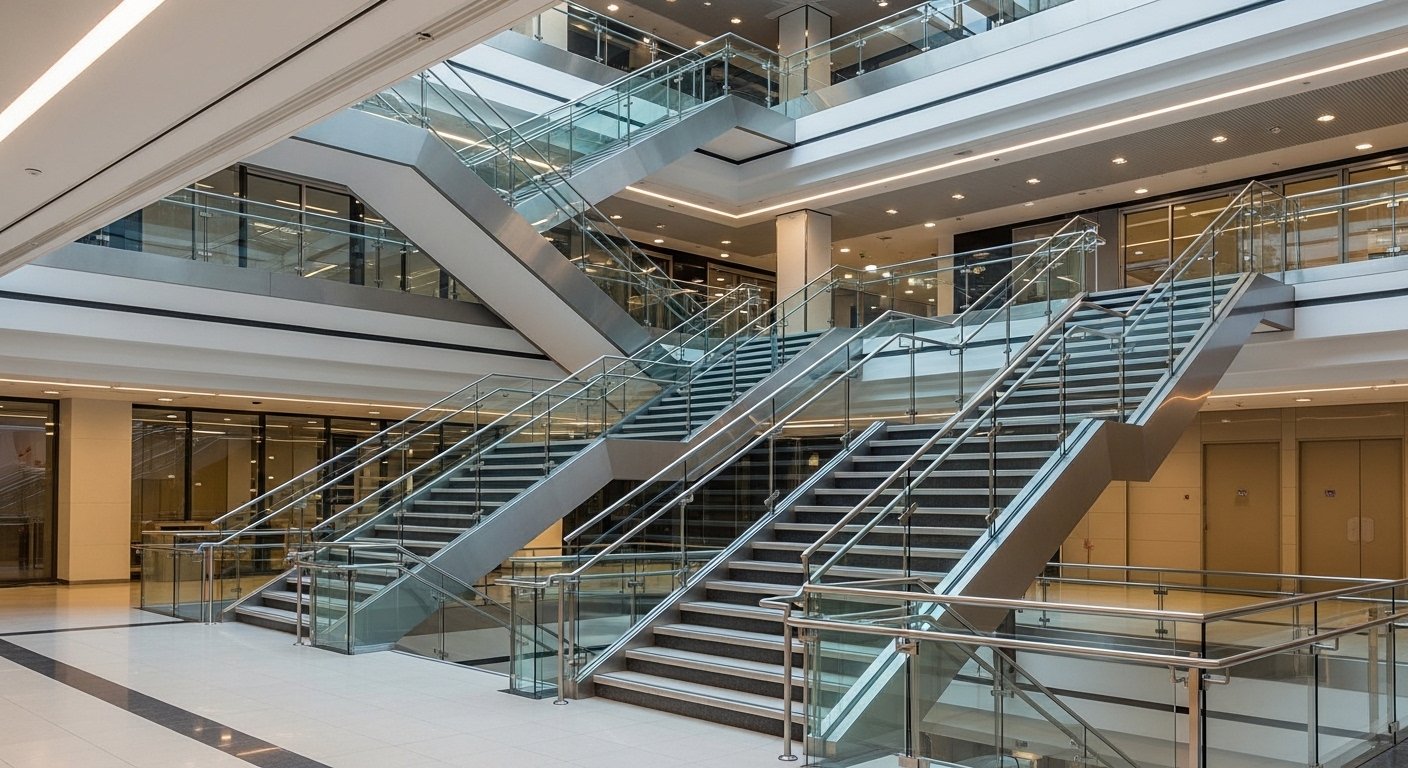
Glass railing systems for national infrastructure programmes — assembly load documentation, Toughened Laminated Glass with 1.52 mm PVB Interlayer or Approved Equivalent in public zones, SS 316 fixings in wash-down areas. Aviation sector guide · Metro case study.
Airports — terminal concourses and mezzanine edges at 3.0 kN/m with SGP or PVB laminated panels. Metro stations — platform and circulation balustrades. Railway stations — footbridges and concourse guards. Foot over bridges — wind-engineered panel design per IS 875 Part 3. Transit facilities — bus terminals and interchanges. Ports & marine facilities — SS 316 standoff systems with passivated fixings.
Pan-India supply for developer and EPC programmes on tower and campus projects. Phased floor-wise delivery with IS 875 documentation per wing.
High-rise towers and commercial towers — frameless balcony and terrace guards with floor-wise wind calcs. Mixed-use developments — podium, retail and office zones with zone-specific load tiers. Corporate headquarters, business parks, IT parks and office campuses — semi-frameless and spigot systems for lobbies and podium decks. IT park sector guide · High-rise sector guide.
Glass balustrades for hospitals, medical colleges and healthcare campuses — fragment-retention glazing, smooth profiles for infection-control wipe-down. Healthcare sector guide · Hospital case study.
Hospitals, medical colleges, diagnostic centres, research facilities and healthcare campuses — Toughened Laminated Glass with 1.52 mm PVB Interlayer or Approved Equivalent specified in patient circulation and public areas; 1.5 kN/m corridor loads.
Glass railing supply for universities, engineering colleges and research campuses. GeM-compatible documentation for institutional procurement.
Universities, educational institutions, engineering colleges, research campuses and training centres — post-and-glass or framed systems for atria, stair cores and terrace guards with NBC compliance packs.
Frameless and spigot systems for hotels, resorts, retail and exhibition facilities.
Hotels, resorts, convention centres — pool and terrace frameless guards; SS 316 in humidity zones. Retail centres and exhibition facilities — mall atria and multiplex void edges at assembly load tiers.
Glass balustrade packages for government buildings, courts and public sector projects with CPWD-format submittals.
Government buildings, courts, secretariat complexes, defence facilities and public sector projects — documented IS 875 and NBC compliance for authority review.
Framed and post-and-glass systems for industrial campuses where structural performance is prioritised. See industrial safety railings.
Industrial campuses, manufacturing facilities, pharmaceutical plants and R&D facilities — mezzanine edges and viewing galleries with 1.5 kN/m guards.
All glass railing systems supplied by Railings India are designed to resist the minimum horizontal loads specified in IS 875 Part 5 and NBC 2016. Load calculation documentation is provided with every commercial and institutional project order.
| Occupancy Type | Min Horizontal Load | NBC 2016 Reference |
|---|---|---|
| Offices and commercial buildings | 1.5 kN/m | Table 2, Clause 3.3.2 |
| Assembly areas and public spaces | 1.5 kN/m | Table 2, Clause 3.3.3 |
| Stadiums and grandstands | 3.0 kN/m | Table 2, Clause 3.3.4 |
| Airport terminals and metro stations | 1.5–3.0 kN/m | As per structural engineer specification |
| Hospital corridors and ward balconies | 1.5 kN/m | Table 2, Clause 3.3.2 |
| High-rise tower balconies (G+14+) | 1.5 kN/m | IS 875 Part 3 wind zone |
Unified engineering reference for PMC teams, structural consultants and EPC contractors reviewing glass balustrade submittals.
Heat-treated to minimum 90 MPa surface compressive stress. On fracture, breaks into small blunt fragments. Standard for interior commercial balconies and stairs where fragment retention is managed by context.
Two toughened plies bonded with 1.52 mm PVB interlayer per IS 16613. On fracture, interlayer retains glass in place — mandatory for public assembly areas, hospitals, schools and high-rise exposed elevations.
1.52 mm PVB interlayer — standard fragment-retention specification for commercial balconies and corridors. Approved equivalent interlayer systems — project-specific equivalents accepted with MTC confirmation. SGP interlayers — higher structural stiffness and post-breakage retention for airports, assembly zones and structural glass fins. Specified for high-rise applications above G+20, public assembly areas and infrastructure projects where post-breakage retention is a safety requirement.
Minimum 12 mm toughened or 10.38 mm toughened laminated glass with 1.52 mm pvb interlayer or approved equivalent for standard commercial guards. Towers above G+15 and coastal zones require project-specific IS 875 Part 3 confirmation — typically 12 mm toughened laminated glass with 1.52 mm pvb interlayer or approved equivalent minimum, stepping to 12.38 mm SGP at assembly and corner zones.
IS 875 Part 3 wind pressure increases with building height and wind zone. Horizontal imposed loads per IS 875 Part 5 / NBC 2016: 0.75 kN/m residential balconies, 1.5 kN/m commercial, 3.0 kN/m assembly. Glass panel deflection checked against project structural engineer criteria on shop drawing issue. See IS 875 load calculation guide.
NBC 2016 Part 4: 1050 mm commercial guard height; 100 mm sphere must not pass through openings below guard. Edge protection via cap rail or structural glass fin as specified on GFC drawings.
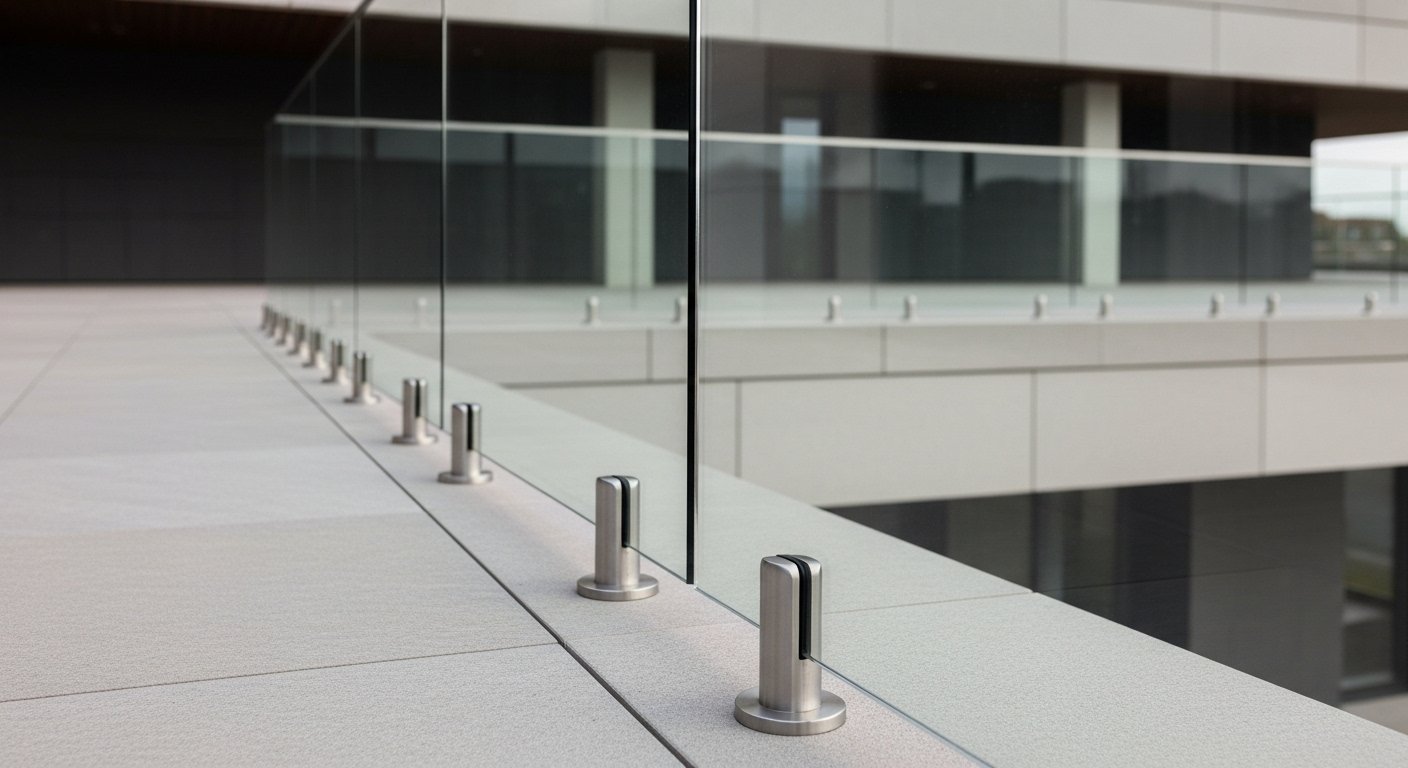
U-channel base fixing — SS 304/316 channel on slab edge with structural silicone and neoprene packers. Standoff / spigot — point-fixed fittings for maximum transparency. Clamped post system — SS posts at 900–1200 mm centres; panels replaceable without disturbing structure. Top rail options: 42 mm or 50 mm SS tube per handrails specification.
Periodic inspection of sealant, anchor torque and panel condition. O&M manual supplied at handover with panel replacement procedure and sealant maintenance intervals.
All glass railing systems are available with a range of post, channel and hardware finishes to match project specifications. Standard and custom profiles are available for bulk orders.
Clear toughened glass (IS 2553), clear laminated glass (IS 16613 PVB), tinted toughened glass (bronze, grey, green), frosted glass for privacy screens, and low-iron ultra-clear glass for premium applications.
SS 304 mirror polish, SS 304 hairline satin, SS 316 marine grade for coastal and chloride-exposed fixings, powder-coated aluminium in RAL colours, and anodised aluminium. Custom colour matching available for large orders.
Round tube 38.1mm and 50.8mm diameter, flat bar, oval profile and custom-extruded profiles. Top-mount, side-mount and core-drill fixing options for concrete, steel and timber substrates.
Railings India, part of Sun Corporation India, manufactures frameless glass balustrade, standoff and base-channel railing systems from Hyderabad for high-rise developers, airport authorities, PMC consultants and EPC contractors on premium facade and balcony programmes. Reference supply includes G+40 Residential Tower (Hyderabad) frameless glass balustrades (1,200 lm), Airport Terminal Expansion (South India) laminated glass balustrades and SEZ IT Park (Bengaluru) podium deck glazing — with IS 875 Part 3 wind calculations, IS 16613 / IS 2553 glass MTCs and NBC 2016 height compliance supplied as standard on glass railing orders.
Reference specification matrix for PMC technical submittals and EPC tender BOQs. Values align to NBC 2016 Part 4, IS 875 Parts 3 and 5, and IS 16613 laminated safety glass. Residential balconies at 0.75 kN/m; commercial and assembly zones at 1.5–3.0 kN/m.
| Application | NBC occupancy | Min height (mm) | Load (kN/m) | Glass system | Glass spec | Standard |
|---|---|---|---|---|---|---|
| High-rise residential balcony — frameless | Residential | 1050 | 0.75 + wind | Base channel / slab edge | 12 mm laminated (IS 16613) | NBC + IS 875 Part 3 |
| G+40 tower typical floor balcony | Residential | 1050 | 0.75 + wind | SS 304 U-channel frameless | 12 mm toughened / laminated | IS 875 Zone III |
| Commercial atrium / mezzanine edge | Commercial | 1050 | 1.5 | SS post + glass infill | 10.38 mm laminated | NBC 2016 Part 4 |
| Airport terminal balustrade | Assembly | 1100–1200 | 3.0 | SS 316 standoff / post | 12.38 mm SGP laminated | NBC + AAI margin |
| IT park podium / terrace deck | Commercial | 1050 | 1.5 | Pin-fixed / standoff glass | 12 mm laminated | NBC commercial |
| Coastal high-rise exterior balcony | Residential / commercial | 1050 | 0.75–1.5 + wind | SS 316 standoff system | 12.38 mm laminated min. | IS 875 Zone III/IV · SS 304 vs SS 316 guide |
| Staircase glass balustrade | Commercial | 900 (from nosing) | 1.5 | SS rail + glass panel | 10–12 mm toughened | NBC + IS 2553 |
| Building height / zone | Glass spec | Fixing system | Rationale |
|---|---|---|---|
| Up to G+15 — inland residential | 10–12 mm laminated (IS 2553) | SS 304 base channel | Standard frameless residential specification |
| G+20 to G+40 — wind-critical floors | 12 mm laminated minimum | SS 316 standoff or U-channel | IS 875 Part 3 wind pressure increase with height |
| Airport / assembly public zone | 12.38 mm SGP laminated | SS 316 post + laminated infill | 3.0 kN/m assembly load + impact safety |
| Coastal high-rise (Zone III–IV) | 12.38 mm laminated min. | SS 316 marine-grade fixing — see SS 304 vs SS 316 selection guide | Chloride corrosion + wind load combined |
Procurement comparison for PMC and EPC teams selecting glass balustrade systems by environment and maintenance profile.
| System Type | Glass Type | Thickness | Support Method | Typical Application | Recommended Environment | Maintenance Level |
|---|---|---|---|---|---|---|
| Frameless base channel | Toughened Laminated Glass with 1.52 mm PVB Interlayer or Approved Equivalent | 10.38–12 mm | SS U-channel slab edge | Tower balcony | Inland commercial | Medium |
| Spigot / standoff | Toughened or Toughened Laminated Glass with 1.52 mm PVB Interlayer or Approved Equivalent | 12–15 mm | Point-fixed SS 316 | Airport, hotel lobby | Assembly interior | Medium |
| SS post + glass | Toughened Laminated Glass with 1.52 mm PVB Interlayer or Approved Equivalent | 10.38–12.38 mm | Clamped posts 1.2–1.5 m | Mall atrium, metro | High-traffic public | Medium |
| Aluminium post + glass | IS 2553 toughened | 10–12 mm | Aluminium frame | Office campus | Dry commercial | Low |
| Structural glass fin | SGP Toughened Laminated Glass with 1.52 mm PVB Interlayer or Approved Equivalent | 12.38 mm+ | Structural glass fin | Feature stair, atrium | Premium commercial | High |
| Balcony frameless | Toughened Laminated Glass with 1.52 mm PVB Interlayer or Approved Equivalent | 12 mm min. | SS 316 coastal channel | Coastal tower | Marine exposure | Medium |
| Staircase glass balustrade | IS 2553 toughened | 10–12 mm | SS cap rail + panel | Commercial stair | Interior circulation | Low |
| Assembly balustrade | SGP Toughened Laminated Glass with 1.52 mm PVB Interlayer or Approved Equivalent | 12.38 mm | SS 316 post system | Airport concourse | 3.0 kN/m assembly | Medium |
Decision reference for PMC teams selecting glass balustrade systems. See balcony railings guide and SS vs Aluminium procurement guide.
| Factor | Frameless channel | Standoff / pin-fixed | Post + glass infill | Semi-frameless cap rail |
|---|---|---|---|---|
| Typical application | High-rise balconies | Atria, premium facades | Airports, commercial | Staircase / mezzanine |
| Aesthetic | Uninterrupted glass edge | Minimal visible hardware | Structural clarity | Handrail + glass panel |
| Wind load suitability | Up to G+25 inland | G+40+ with calc | Assembly / high-traffic | Interior / low-wind |
| Sector guide | High-rise | IT parks | Aviation | Healthcare |
| Product page | Glass railings | Balcony railings | SS railings | Staircase railings |
Railings India supports commercial glass railing programmes from site survey through handover: site surveys, engineering support, shop drawings, fabrication drawings, material approvals, sample and mock-up approvals, quality inspections, project coordination and installation support. Single POC for PMC, structural consultant and EPC teams.
Specification references: IS 875 Part 3 load calculation guide · Specification glossary · SS vs aluminium procurement guide. Request full submittal via project enquiry.
| # | Document | Format | PMC use |
|---|---|---|---|
| 1 | IS 875 Part 3 wind load calculation — glass panel | PDF + calc sheet | Design basis approval |
| 2 | IS 875 Part 5 guardrail load confirmation (0.75 / 1.5 / 3.0 kN/m) | BOQ / spec verification | |
| 3 | NBC 2016 height compliance — 1050 mm statement | Authority / RERA submittal | |
| 4 | AutoCAD shop drawings — slab edge channel / standoff layout | DWG + PDF | Design freeze / GFC |
| 5 | Glass MTC — IS 2553 toughened / IS 16613 laminated | PDF per batch | Material approval |
| 6 | SS fixing MTC — IS 6911 grade 304 / 316 | PDF per batch | Material approval |
| 7 | Structural engineer glass panel sign-off letter | PMC structural review | |
| 8 | Installation method statement — channel grouting / standoff torque | Site safety plan | |
| 9 | Third-party inspection coordination letter | PMC QA protocol | |
| 10 | O&M manual — panel replacement, sealant maintenance | Handover dossier |
PMC pre-submittal checklist: □ NBC 1050 mm height confirmed □ IS 875 wind zone on calc sheet □ Glass thickness by floor height □ Laminated glass in public / balcony zones □ 100 mm sphere rule verified □ Shop drawings stamped pre-GFC □ SS 316 for coastal / high-wind zones
| Stage | EPC action | Railings India deliverable | Duration | Approval gate |
|---|---|---|---|---|
| 1. Enquiry | Share GA, balcony schedule, wind zone, glass type · Submit enquiry | Budgetary spec + glass thickness matrix | 2–3 days | PMC technical review |
| 2. Technical submittal | Issue LOI / draft PO | Full document pack (items 1–8) | 5–7 days | PMC + developer |
| 3. Shop drawing approval | Comment slab edge, channel depth, panel sizes | Revised stamped drawings | 7–10 days | PMC design freeze |
| 4. GFC release | Confirm quantities per floor / tower | Final BOQ + production release | 2 days | EPC procurement |
| 5. Fabrication | — | Hyderabad factory QA + batch glass MTCs | 3–6 weeks | EPC factory inspection (optional) |
| 6. Mock-up (if required) | Install sample balustrade on site | Panel + fixing approval report | 1–2 weeks | Architect + PMC sign-off |
| 7. Dispatch & installation | Floor-wise delivery aligned to slab programme | Packed glass panels + channel hardware | Per programme | Site logistics plan |
| 8. Handover | Submit as-built + dossier | O&M manual + NBC / IS 875 compliance pack | 3–5 days | PMC close-out |
Project references drawn from Railings India portfolio on case studies and projects. No additional project names introduced.
| Project / zone | Sector | Scope | Key specification | Documentation |
|---|---|---|---|---|
| G+40 Residential Tower | High-rise tower | Frameless glass balustrade — all typical floors | 1,200 lm, 12 mm toughened, SS 304 U-channel | IS 875 + NBC 1050 mm |
| Airport Terminal Expansion | Aviation | Frameless glass balustrade + SS handrails — terminal zones | 12.38 mm SGP, SS 316, 3.0 kN/m | IS 875 + AAI submittal |
| SEZ IT Park (Bengaluru) | Corporate / SEZ | Podium deck glass balustrade — 3 towers | 12 mm laminated, 12,000 sqft scope | ECBC + shop drawings |
| Metro Rail — 14 Stations | Infrastructure | Platform and circulation glass balustrade | SS 316, 1.5–3.0 kN/m, PVB laminated | IS 875 + NBC submittal |
| 800-Bed Multi-Speciality Hospital | Healthcare | Corridor and atrium glass balustrade | 10.38 mm PVB laminated, 1.5 kN/m | HAG + NBC pack |
Outcome — G+40 Residential Tower: Frameless glass balcony balustrade across all typical floors — 1,200 lm with floor-wise IS 875 Part 3 wind calculations and NBC 1050 mm compliance statements for developer PMC submittal.
High-rise case study → · Airport case study → · Metro case study → · Hospital case study → · Aviation sector guide → · Manufacturer credentials →
Stainless steel railings · Staircase railings · Balcony railings · Aluminium railings · Handrails · Industrial safety railings · NBC 2016 guide · Manufacturer credentials · Projects · Case studies
For GFC and PMC design freeze, project teams typically require: slab-edge channel or standoff layout, glass make-up (IS 2553 / IS 16613 with 1.52 mm PVB where specified), NBC 1050 mm height confirmation, and SS hardware grade on the schedule. Railings India issues stamped shop drawings and calc sheets for PMC, structural consultant and EPC review. Coastal and wash-down zones: specify SS 316 fixings.
| Drawing issue | PMC / structural review point | Railings India deliverable |
|---|---|---|
| Concept / SD | System type — frameless vs post-and-glass | System comparison matrix + NBC height reference |
| DD / GFC | Glass thickness, wind zone, slab edge detail | Stamped shop drawings + IS 875 Part 3 calc |
| Coastal / high-rise | SS grade, PVB / SGP spec, load tier | SS 304 vs SS 316 guide + MTC pack |
Share GA drawings, balcony schedule or atrium layouts. Our engineering team confirms system type, IS 875 load tier and PMC documentation scope.
Technical response within 24 business hours.
What is the standard height of glass railing on a commercial building in India?
1050 mm from finished floor level to the top of the glass panel or capping rail per NBC 2016 Part 4. Assembly zones — mall atria, airport landside, metro platforms — often specify 1100–1200 mm as a project safety margin. See the NBC 2016 height reference.
What glass thickness is required for commercial balcony and terrace railings?
Minimum 12 mm toughened (IS 2553) or 10.38 mm Toughened Laminated Glass with 1.52 mm PVB Interlayer or Approved Equivalent. Exposed elevations on towers above G+15 in Wind Zones III–V require project-specific IS 875 Part 3 confirmation.
What is the difference between frameless and semi-frameless glass railings for commercial projects?
Frameless systems use a base channel or spigot with no vertical posts — specified for airports, hotel lobbies and prestige commercial interiors. Semi-frameless systems use SS posts at 1.2–1.5 m intervals with glass infill — standard for IT parks, hospital corridors and commercial tower terraces. Both require IS 875 documented design.
Does Railings India supply glass railings with full documentation for EPC tender submission?
Yes. Every commercial and institutional order includes signed IS 875 calculations, NBC compliance statement, shop drawings, glass and SS material test certificates, and installation method statement. Third-party inspection coordination for airports, metro and hospitals.
When is laminated glass mandatory instead of toughened glass for commercial railings?
Where fragment retention is required — hospital public areas, schools, overhead glazing, high-exposure facade zones above G+20. Specify Toughened Laminated Glass with 1.52 mm PVB Interlayer or Approved Equivalent, or SGP interlayer at assembly zones, per structural engineer and project safety plan.
Are your glass railing systems IS 875 compliant?
Yes. All systems are engineered to IS 875 Part 3 wind load requirements and NBC 2016 structural provisions. Full load calculation documentation for every institutional and commercial project.
Do you supply glass railings for GeM portal and government projects?
Yes. CPWD specification cross-reference and GeM-compatible quotation formats on request.
Do you supply glass railings across India for multi-site developments?
Yes. Pan-India fabrication and delivery with phased dispatch coordinated to EPC construction programme — single POC for PMC and procurement teams.
When is SS 316 required instead of SS 304 for glass railing fixings?
SS 316 is mandatory for standoffs, base channels, posts and handrails within 5 km of the coastline, swimming pool surrounds, and airport/metro wash-down zones. SS 304 suits inland commercial interiors. See the SS 304 vs SS 316 guide.
What documentation do PMC teams need for glass balustrade GFC submittal?
PMC submittal typically requires: NBC 2016 height statement (1050 mm commercial), IS 875 Part 3 wind calculation by floor, glass make-up on shop drawings, 100 mm sphere rule compliance, and SS hardware finish confirmation. Railings India supplies stamped shop drawings and calc sheets for GFC freeze.
What are glass railings and how are they used in commercial buildings?
Glass railings are guard systems using IS 2553 toughened or IS 16613 laminated panels with SS or aluminium support hardware. Used at balconies, atria, stairs and infrastructure circulation in airports, towers, hospitals, malls and campuses nationwide.
What is the difference between toughened and laminated glass for railings?
Toughened glass (IS 2553) fractures into small blunt pieces. Toughened Laminated Glass with 1.52 mm PVB Interlayer or Approved Equivalent retains fragments in place — required in public assembly, healthcare and high-rise exposed zones.
What is a 1.52 mm PVB interlayer and when is it specified?
PVB bonds two glass plies for fragment retention per IS 16613. Standard for commercial balconies, corridors and public zones. SGP interlayers used where higher post-breakage stiffness is required at airports and assembly areas.
What is a base shoe glass railing system?
An aluminium or SS profile at slab edge receiving the glass panel — efficient for straight balcony runs on repeatable tower floors. Anchor and grouting details on shop drawings and method statement.
What is a spigot glass railing system?
Point-fixed SS fittings at two or four locations per panel. Maximum transparency for airport concourses and hotel lobbies. Requires precise slab-edge setting and SS 316 in wash-down zones.
How do structural glass railings differ from post-and-glass systems?
Structural systems use glass fins or heavy laminated panels to carry load with minimal metal visible. Requires structural engineer sign-off and SGP interlayer at premium commercial and assembly applications.
What glass thickness is required for high-rise towers above G+30?
Typically 12 mm Toughened Laminated Glass with 1.52 mm PVB Interlayer minimum, with floor-wise IS 875 Part 3 wind calcs. Corner and parapet zones may require 12.38 mm SGP laminated per structural engineer specification.
How does IS 875 Part 3 affect glass panel design on tall buildings?
Wind pressure increases with height and wind zone. Railings India supplies signed calc sheets showing floor-wise pressure and confirmed glass thickness for PMC and structural consultant review.
What deflection limits apply to glass balustrade design?
Panel deflection checked against project structural engineer criteria on shop drawing issue — typically L/100 to L/150 of panel span depending on fixing system and occupancy load tier.
What fixing method is used for slab-edge frameless glass railings?
SS U-channel base shoe anchored to slab edge with structural silicone and neoprene packers. Torque and grouting sequence in installation method statement. SS 316 mandatory within 5 km of coastline.
What maintenance is required for commercial glass balustrades?
Periodic inspection of sealant, anchor condition and panel integrity. O&M manual supplied at handover with panel replacement procedure and cleaning guidance.
Are glass railings suitable for hospital corridors and patient areas?
Yes — specify Toughened Laminated Glass with 1.52 mm PVB Interlayer in public and patient circulation zones. Smooth profiles for infection-control wipe-down. See the healthcare sector guide.
What glass railing systems are specified for educational campuses?
Post-and-glass or framed systems for atria, stair cores and terrace guards. GeM-compatible documentation for institutional procurement.
What systems are used for metro platform edge balustrades?
SS 316 post-and-glass or frameless systems at 1.5–3.0 kN/m with PVB or SGP laminated panels. Full MTC and IS 875 submittal pack. See metro case study.
Can glass railings be supplied for foot over bridges and transit facilities?
Yes — wind-engineered panel design per IS 875 Part 3 with documented fixings for FOB and bus terminal circulation zones.
What NBC 2016 safety requirements apply to glass balustrades?
1050 mm commercial guard height; 100 mm sphere rule on openings; load tiers 0.75 / 1.5 / 3.0 kN/m by occupancy. See NBC 2016 height reference.
What is the 100 mm sphere rule for glass railing openings?
Balustrade design must prevent passage of a 100 mm diameter sphere through any opening below the guard — per NBC 2016 Part 4.
What documentation is included in a glass railing PMC submittal pack?
IS 875 Part 3 calcs, Part 5 load confirmation, NBC height statement, shop drawings, glass and SS MTCs, method statement, inspection letter and O&M manual — see PMC checklist on this page.
How do glass railings compare to stainless steel railings for commercial projects?
Glass maximises transparency and facade aesthetics; SS tube systems offer higher impact resistance in heavy-traffic service zones. Many projects specify both by zone. See stainless steel railings and SS vs aluminium procurement guide.
How do I request a glass railing quotation and PMC submittal pack?
Submit tower GA, balcony schedule or atrium drawings via project enquiry. Technical response within 24 hours with system recommendation and compliance matrix. Phone +91 98490 90479.
Every system engineered to Indian wind load standards. Full structural documentation for institutional procurement and EPC tendering.
Fabricated to your structural drawings and project briefs. Custom glass sizes, post spacing, profiles and finishes handled in-house.
Manufacturing capacity for large-quantity orders. Phased delivery to match construction programme across multiple project sites.
Load calculations, shop drawings, BIS certificates, NBC compliance reports and material test certificates with every order.
Submit tower drawings for stamped shop drawings, IS 875 calculations and NBC compliance statements.
Technical response within 24 business hours.
Explore our full range of commercial railing systems — glass, stainless steel, aluminium and industrial specifications for pan-India commercial and infrastructure projects.
Interior and atrium specifications may also use our frameless glass systems for office partitions.
Specification guides and compliance notes for glass railing projects.
Glass Railing Load Calculations to IS 875 Part 3
Read guide →
NBC 2016 Railing Height Requirements — Complete Reference
Read guide →
NBC 2016 Glass Partition Requirements — Commercial Buildings
Read guide →
Stainless Steel vs Aluminium — Procurement Specification Guide
Read guide →
SS 304 vs SS 316 — Coastal Glass Railing Fixings
Read guide →