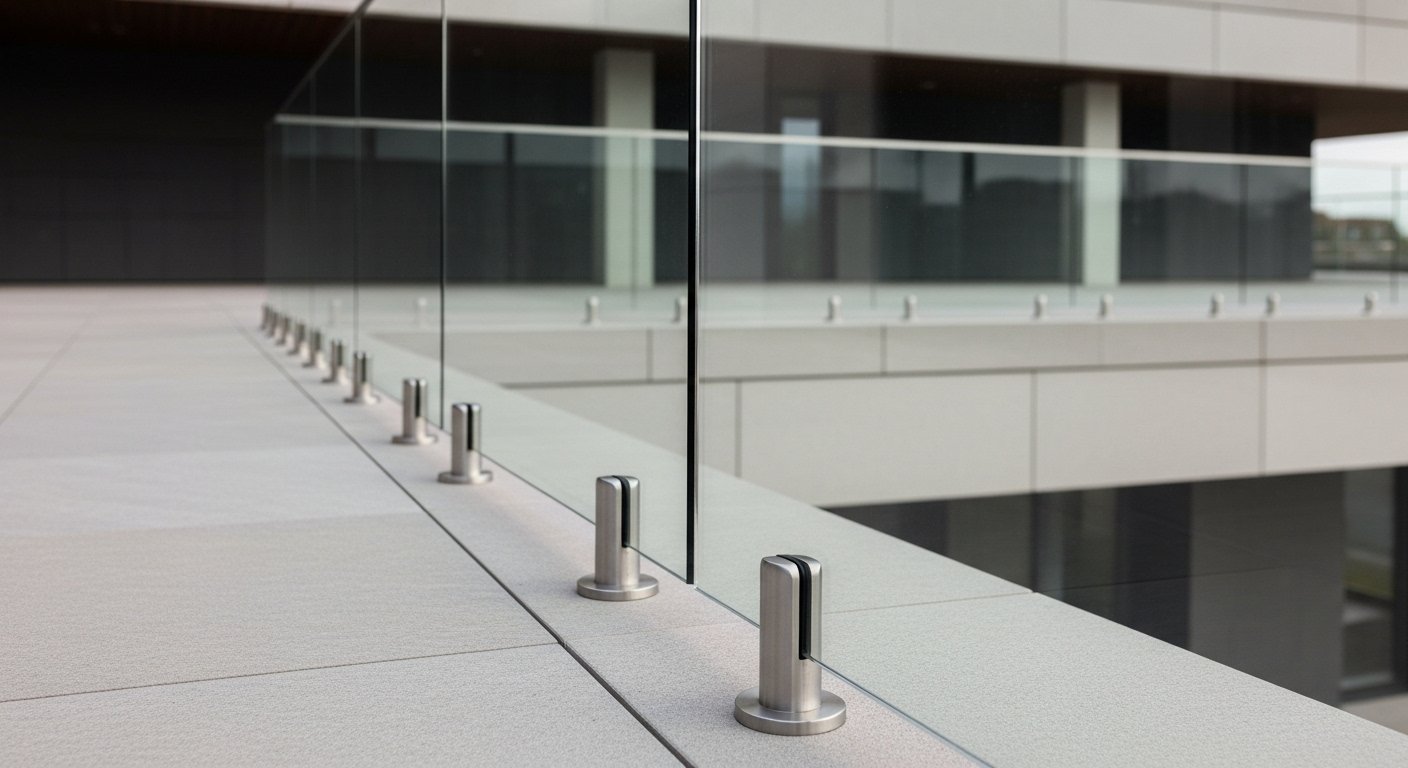
RI-SP-01 spigot glass railing systems for commercial towers, airports, metro, hospitals, IT parks and public infrastructure — SS and aluminium spigot assemblies, IS 2553, IS 16613, IS 875 and NBC 2016 documented. Pan-India supply for PMC, EPC and developer procurement teams.
Get a QuoteA spigot glass railing system is a glass balustrade assembly where toughened or laminated glass panels are supported at the slab edge or floor level by engineered stainless steel or aluminium spigot assemblies — point-fixed fittings that clamp or support the glass panel while maintaining open views with minimal visible structure. RI-SP-01 is Railings India's engineered spigot glass railing system for commercial, institutional and infrastructure projects.
How does it work? Spigot systems transfer lateral loads from the glass panel through each spigot assembly to chemical or mechanical anchors in the structural slab. Where is it used? Commercial tower terraces, podium decks, airport concourses, metro circulation, hospital atria, IT park balconies and hospitality feature zones where point-fixed aesthetics, documented spigot spacing and repeatable installation on floor plates are project requirements. Spigot assemblies are supplied in SS 304, SS 316 or 6063-T5 aluminium depending on environment and finish specification.
What glass is used? IS 2553 toughened safety glass or IS 16613 toughened laminated glass with 1.52 mm PVB interlayer or approved equivalent in public and assembly zones. Standards: IS 2553, IS 16613, IS 875 Parts 3 and 5, NBC 2016 Part 4. Engineering documentation includes IS 875 Part 3 wind load design, NBC 2016 guard height compliance and stamped shop drawings for PMC submittal.
RI-SP-01 is a spigot glass railing system that supports toughened or laminated glass panels using engineered stainless steel or aluminium spigot assemblies, providing structural stability while maintaining open views for commercial, institutional and infrastructure projects. Railings India is a spigot glass railing system manufacturer, glass railing fabricator, commercial engineering partner and project delivery specialist — factory-direct from Hyderabad for pan-India commercial programmes.
Glass railings authority hub · Frameless Glass Railing System · Base Shoe Glass Railing System · Manufacturer hub · Manufacturer credentials · NBC 2016 guide · Case studies
RI-SP-01 is Railings India's principal spigot glass railing system entity — engineered for commercial, institutional and infrastructure projects requiring point-fixed spigot assembly support with documented structural performance. The system combines IS 2553 / IS 16613 glass infill with SS 304, SS 316 or 6063-T5 aluminium spigot assemblies, chemical anchor fixing and full PMC submittal documentation.
Structural concept: Point-supported glass guard panels secured by spigot assemblies at the slab edge — load path through glass panel to spigot to anchors. Point-fixed support: Discrete spigot spacing along straight runs on repeat floor plates. Open views: Minimal visible structure at floor level — specified for tower balconies, podiums, concourses and commercial terraces.
Commercial applications: Commercial tower balconies, airport concourses, metro circulation, hospital atria, university podiums, IT park terraces and government public facilities. Engineering considerations: Wind load per IS 875 Part 3, spigot spacing, anchor pull-out, drainage and NBC guard height — detailed on stamped shop drawings for each RI-SP-01 order.
Six principal RI-SP-01 configuration variants — each identified for PMC submittals, BOQs and technical coordination. All configurations use IS 2553 or IS 16613 glass with IS 875 and NBC 2016 documentation.
System: SS 304 or SS 316 spigot assemblies at slab edge. Applications: commercial tower balconies, podium decks, stainless steel spigot railing runs. Engineering: spigot spacing, chemical anchor torque, structural silicone bedding. Glass: 12 mm toughened or 12–13.52 mm laminated with 1.52 mm PVB interlayer or approved equivalent. Typical use: high-rise towers, mixed-use podiums.
System: 6063-T5 aluminium spigot assemblies with powder coat or anodise finish. Applications: IT park atria, podium decks, architectural glass railing spigot zones. Engineering: spigot spacing, precision alignment. Glass: 12 mm laminated minimum. Typical use: IT parks, corporate campuses.
System: Surface-mount spigot assemblies on slab edge or floor level. Applications: hospitality atria, feature balconies, terrace spigot glass balustrade runs. Engineering: SS 316 in coastal zones; documented spigot spacing. Glass: 12 mm laminated minimum. Typical use: hotels, convention centres.
System: Glass supported by recessed or flush spigot assemblies in prepared slab recess. Applications: premium commercial lobbies, feature zones. Engineering: slab coordination, integrated drainage and fixing access. Glass: 12–15 mm laminated with 1.52 mm PVB interlayer or approved equivalent. Typical use: prestige commercial interiors.
System: Wind-engineered spigot packages for tower slab-edge balconies. Applications: G+25+ commercial towers, exposed elevation balconies. Engineering: floor-wise IS 875 Part 3 wind documentation. Glass: 13.52–15 mm laminated with 1.52 mm PVB interlayer or approved equivalent. Typical use: commercial tower repeat floor plates.
System: SS 316 heavy spigot assemblies with assembly-rated laminated glass. Applications: airports, metro stations, railway platforms, government public facilities. Engineering: 1.5–3.0 kN/m assembly load tiers. Glass: 12–15 mm laminated with 1.52 mm PVB interlayer or approved equivalent. Typical use: national infrastructure programmes.
IS 2553 heat-treated safety glass — 10–12 mm typical on protected interior RI-SP-01 zones with low wind exposure and no public assembly post-breakage requirement. Impact-resistant specification for commercial circulation where laminated make-up is not mandated.
IS 16613 toughened laminated glass — two toughened lites bonded with PVB or approved equivalent interlayer. Standard specification for slab-edge, coastal, high-rise exposed and public assembly zones on RI-SP-01 spigot glass balustrade programmes.
1.52 mm PVB interlayer or approved equivalent — standard fragment-retention interlayer in IS 16613 laminated glass. Approved equivalent interlayers (SGP or project-specified) may be used where structural glass engineering and MTC documentation confirm compliance with post-breakage performance requirements.
Thickness selected by building height, wind zone (IS 875 Part 3), panel span, spigot spacing and assembly load tier — 12 mm toughened minimum on standard commercial slab-edge; 13.52–15 mm laminated on coastal, high-rise and public zones. Full schedule on RI-SP-01 shop drawings. See glass railings hub for category-wide thickness guidance.
Laminated glass with 1.52 mm PVB interlayer or approved equivalent retains glass fragments after breakage — required in public circulation, assembly-rated zones and slab-edge balconies per project safety review. Structural performance verified through IS 875 load documentation and deflection checks at each glass railing spigot — not generic glass supply.

RI-SP-01 spigot glass railing systems use engineered SS 304 or SS 316 spigot assemblies at each glass panel support point — providing clamp or pin-type fixing with documented torque and sealant specification. SS spigots are the standard specification for commercial stainless steel spigot railing programmes on tower balconies and public infrastructure.
6063-T5 aluminium spigot assemblies with powder-coated or anodised finish for architectural IT park and atrium spigot glass balustrade installations — coordinated with aluminium railings material specification depth.
Surface-mounted spigot assemblies anchored to the slab edge with chemical or mechanical fasteners — neoprene packers and structural silicone bedding specified in installation method statement for RI-SP-01-SM configurations.
Recessed spigot assemblies set into prepared slab pockets for RI-SP-01-RM configurations — slab coordination, integrated drainage and concealed fixing access documented on shop drawings.
Chemical anchors to ETAG-rated substrates; torque and grouting sequence in installation method statement; pull-out tests where specified. Spigot anchor spacing coordinated with structural engineer on post-tensioned and composite slab edges — documented on RI-SP-01 shop drawings.
Spigot spacing and glass panel deflection control alongside glass thickness selection. Weep details and neoprene packer spacing allow water egress at spigot fixings — specified in installation method statement for exposed podium and balcony elevations.
SS 316 spigots specified within 5 km of coastline; SS 304 for standard inland commercial; aluminium spigots with powder coat or anodise for architectural finish programmes. See stainless steel railings for material specification depth.
Spigot assembly design includes accessible anchor zones where specified — supporting periodic torque inspection, sealant review and hardware verification per O&M manual on commercial spigot glass railing system programmes.
Point-supported glass systems in the spigot glass railing system category use discrete spigot fixings rather than continuous base channels — each glass panel supported at engineered spigot locations along the slab edge. Load transfer occurs through the glass lite to each glass railing spigot and into the structural substrate.
Point-supported configurations are specified where architects require uninterrupted glass spans with minimal floor-level hardware visibility — common on commercial tower terraces, airport viewing galleries and hospitality feature balconies. Spigot count, spacing and glass thickness are coordinated per IS 875 Part 3 on each RI-SP-01 order.
For continuous base channel alternatives, see the Base Shoe Glass Railing System. For the broader frameless umbrella including embedded channel configurations, see the Frameless Glass Railing System.
Stainless steel spigot railing assemblies (SS 304 / SS 316) are specified for structural durability, coastal corrosion resistance and public infrastructure programmes — RI-SP-01-SS and RI-SP-01-PI configurations. SS 316 is mandatory within 5 km of coastline and in salt-laden wash-down zones.
Aluminium spigot assemblies (6063-T5) are specified where architectural powder coat or anodised finish integrates with facade and atrium design — RI-SP-01-AL configurations on IT park and corporate campus spigot glass balustrade programmes. Glass make-up and spigot spacing requirements are identical; material selection is environment and finish driven.
Both spigot types are documented with MTCs, anchor schedules and installation method statements on RI-SP-01 shop drawings — not generic hardware supply.
Surface-mounted spigot systems (RI-SP-01-SM) anchor spigot assemblies to the top or face of the structural slab — standard for commercial tower balconies, podium decks and terrace spigot glass railing system runs where slab-edge access is straightforward.
Recessed spigot systems (RI-SP-01-RM) set spigot hardware into prepared slab recesses for flush floor-level appearance — specified on premium commercial lobbies and feature zones requiring concealed point fixings and integrated drainage coordination.
Selection depends on slab edge detail, drainage requirements, maintenance access and architectural finish intent — documented on RI-SP-01 configuration schedules for PMC review.
Spigot engineering for RI-SP-01 includes IS 875 Part 3 wind load documentation, spigot spacing calculation, anchor pull-out verification and glass deflection checks — stamped on shop drawings for structural consultant and PMC review.
Load transfer path: imposed and wind loads on glass panel → spigot assembly → chemical or mechanical anchor → structural slab. Point spacing is adjusted for building height, wind zone and panel dimensions on high-rise RI-SP-01-HR packages.
Assembly load tiers per IS 875 Part 5 — 0.75 kN/m residential tier or 1.5–3.0 kN/m assembly commercial tier on RI-SP-01-PI public infrastructure configurations. IS 875 load calculation guide.
Commercial spigot glass railing system maintenance includes annual spigot torque verification, sealant condition assessment, anchor inspection and glass impact review on exposed elevations — per O&M manual supplied at project handover.
Coastal programmes require 5-year sealant review and SS 316 hardware condition inspection. Drainage at spigot fixings checked on exposed podium and balcony zones. Cleaning procedures specified to protect spigot finishes and glass surfaces.
Maintenance schedules are project-specific — documented in the RI-SP-01 O&M manual with spigot layout reference for facility management teams.
RI-SP-01-PI spigot configurations for national infrastructure — assembly load documentation, SS 316 in wash-down zones, full EPC submittal packs. Airports · metro stations · railway stations. Aviation sector guide · Airport case study · Metro case study.
RI-SP-01 packages for developer and EPC programmes on tower and campus projects — floor-wise wind documentation, phased delivery. High-rise towers · commercial towers · IT parks. IT park sector guide · IT park case study · Balcony railings.
RI-SP-01 with laminated glass and smooth spigot hardware finishes for healthcare campuses — 1.52 mm PVB interlayer or approved equivalent in public circulation, NBC-compliant documentation. Hospitals · medical facilities. Healthcare sector guide · Hospital case study.
RI-SP-01 for university atria, podiums and circulation edges — documented submittals for institutional procurement. Universities · educational institutions.
RI-SP-01-SM and RI-SP-01-RM configurations for premium transparency at hospitality programmes. Hotels · convention centres.
RI-SP-01-PI for government buildings and public infrastructure — IS 875 and NBC documentation for authority submittal. Government buildings · public infrastructure.
Engineering documentation for RI-SP-01 is project-specific — full NBC matrices and wind zone tables on the glass railings authority hub and NBC 2016 guide. Summary below for spigot glass railing system specification.
IS 875 Part 3 wind load on exposed glass panels — zone confirmation, elevation factor, spigot spacing and floor-wise documentation on high-rise RI-SP-01-HR packages. IS 875 Part 5 imposed loads at 0.75 kN/m residential tier or 1.5–3.0 kN/m assembly commercial tier. IS 875 load calculation guide.
Panel deflection limited by glass thickness, span between spigots and spigot count — confirmed on structural calculation sheets for PMC review.
Spigot spacing accounts for wind suction, impact and post-breakage retention — laminated make-up with 1.52 mm PVB interlayer or approved equivalent on public zones. Hardware in SS 316 for coastal programmes.
SS 316 spigots specified within 5 km of coastline; SS 304 for standard inland commercial; aluminium spigots with powder coat or anodise for architectural finish programmes.
Annual spigot torque, sealant and drainage inspection on exposed elevations; glass cleaning per O&M manual; 5-year sealant review on coastal RI-SP-01 installations.
Reference matrix for PMC and structural consultant submittals — maps RI-SP-01 configurations to glass, interlayer, spigot type and environment specification.
| System Code | Glass Type | Thickness | Interlayer | Spigot Type | Typical Application | Environment |
|---|---|---|---|---|---|---|
| RI-SP-01 (SS) | Toughened IS 2553 | 12 mm | — | SS 304 surface mount spigot | Inland tower podium | Standard commercial |
| RI-SP-01 (SS) | Toughened laminated IS 16613 | 12–13.52 mm | 1.52 mm PVB interlayer or approved equivalent | SS 304 spigot + silicone | Commercial tower terrace | Wind Zone II–III |
| RI-SP-01 (HR) | Toughened laminated | 13.52–15 mm | 1.52 mm PVB interlayer or approved equivalent | SS 304 high-rise spigot assembly | G+25+ tower slab edge | Exposed elevation |
| RI-SP-01 (PI) | Toughened laminated | 12–15 mm | 1.52 mm PVB interlayer or approved equivalent | SS 316 heavy spigot | Airport · metro · railway | Assembly / public |
| RI-SP-01 (SS) | Toughened laminated | 12 mm min. | 1.52 mm PVB interlayer or approved equivalent | SS 316 marine spigot | Coastal tower balcony | Salt-laden / coastal |
| RI-SP-01 (AL) | Toughened laminated | 12 mm | 1.52 mm PVB interlayer or approved equivalent | 6063-T5 aluminium spigot | IT park podium · atrium | Powder coat / anodise |
| RI-SP-01 (RM) | Toughened laminated | 12–15 mm | 1.52 mm PVB interlayer or approved equivalent | Recessed SS spigot | Premium lobby · feature zone | Concealed fix |
| RI-SP-01 (SM) | Toughened laminated | 12 mm | 1.52 mm PVB interlayer or approved equivalent | SS 316 surface mount spigot | Hospitality · feature balcony | Side-fix / terrace |
Railings India supplies full PMC and EPC documentation for RI-SP-01 spigot glass railing procurement — formatted for design freeze, material approval and authority submittal.
| Deliverable | RI-SP-01 spigot package |
|---|---|
| Shop drawings | Stamped plan/elevation layouts, spigot fixing details, anchor schedule, glass make-up, RI-SP-01 code reference |
| Structural coordination | IS 875 Part 3 wind calcs, spigot spacing, anchor pull-out confirmation with structural engineer |
| Material submittals | IS 2553 / IS 16613 glass MTCs, spigot assembly MTCs, anchor data sheets |
| Mock-ups | Pre-production mock-up panel for glass make-up and spigot fixing approval |
| Quality inspections | Incoming MTC verification, dimensional QA, pre-dispatch inspection report |
| Installation planning | Method statement, torque sequence, sealant specification, drainage detail, O&M manual |
| Stage | Activity | RI-SP-01 deliverable |
|---|---|---|
| 1. Survey | Site measurement, slab edge assessment | Survey report, fixing substrate confirmation |
| 2. Engineering | Load analysis, glass make-up and spigot selection | IS 875 calcs, RI-SP-01 configuration schedule |
| 3. Drawings | Shop drawing preparation | Stamped GFC drawings for PMC review |
| 4. Approvals | Material and mock-up approval | Submittal log, approved glass make-up |
| 5. Fabrication | Glass processing, spigot assembly preparation | Batch MTCs, QA inspection records |
| 6. Inspection | Pre-dispatch QA | Dimensional check vs shop drawings |
| 7. Delivery | Phased site delivery | Delivery notes, panel ID schedule |
| 8. Installation support | Method statement guidance | Torque sequence, sealant spec, drainage detail, O&M handover |
| EPC stage | RI-SP-01 action | Documentation |
|---|---|---|
| Tender / BOQ | RI-SP-01 system code in schedule | Specification matrix + NBC reference |
| Design development | Configuration selection (SS/AL/SM/RM/HR/PI) | System comparison + IS 875 summary |
| GFC submittal | Stamped shop drawings | PMC checklist package |
| Material approval | Glass + spigot submittals | MTCs, mock-up sign-off |
| Installation | Method statement execution | Torque log, batch inspection |
| Handover | PMC + project authority sign-off | O&M manual, as-built drawings |
Request the Railings India Spigot Glass Railing Specification Pack for PMC and EPC submittal preparation — factory-direct documentation from Sun Corporation India, Hyderabad. Not a retail catalogue.
Railings India, part of Sun Corporation India, manufactures RI-SP-01 spigot glass railing systems from Hyderabad for high-rise developers, airport authorities, PMC consultants and EPC contractors on premium facade and balcony programmes — with IS 875 Part 3 wind calculations, IS 16613 / IS 2553 glass MTCs and NBC 2016 height compliance supplied as standard.
| Reference | Sector | RI-SP-01 configuration | Spigot / finish | Documentation |
|---|---|---|---|---|
| Airport Terminal Expansion | Aviation | RI-SP-01-PI concourse | SS 316, 13.52 mm laminated | Authority submittal pack |
| Metro Rail — Multi-Station Programme | Infrastructure | RI-SP-01-PI platform edge | SS 316, 1.5 kN/m | IS 875 + metro authority |
| 800-Bed Multi-Speciality Hospital | Healthcare | RI-SP-01-SM circulation | SS 304, laminated 1.52 mm PVB interlayer or approved equivalent | NBC + PMC pack |
| SEZ IT Park — Corporate Campus | Commercial | RI-SP-01-AL podium deck | 6063-T5 aluminium, 12 mm laminated | Full PMC submittal |
| G+40 Commercial Tower | High-rise | RI-SP-01-HR balcony zones | Floor-wise wind calcs | IS 875 Zone III |
All case studies · Projects · Manufacturer credentials
RI-SP-01 is part of the Railings India commercial glass railing portfolio. Related systems and authority resources:
Glass railings authority hub · Frameless Glass Railing System · Base Shoe Glass Railing System · Aluminium railings · Stainless steel railings · Handrails · Balcony railings · Staircase railings · Manufacturer hub · NBC 2016 guide · IS 875 load guide
What is a spigot glass railing system?
A spigot glass railing system is a glass balustrade assembly where toughened or laminated glass panels are supported at the slab edge by engineered stainless steel or aluminium spigot assemblies — point-fixed fittings that clamp or support the glass while maintaining open views. Each glass railing spigot transfers lateral loads to anchors in the structural slab. Railings India manufactures the RI-SP-01 Spigot Glass Railing System for commercial, institutional and infrastructure projects.
What is the RI-SP-01 spigot glass railing system?
RI-SP-01 is Railings India's engineered spigot glass railing system — IS 2553 toughened or IS 16613 toughened laminated glass supported by SS 304, SS 316 or 6063-T5 aluminium spigot assemblies with documented IS 875 Part 3 wind load design and NBC 2016 guard height compliance. Railings India is a commercial spigot glass railing system manufacturer, fabricator and engineering support provider for pan-India programmes.
How does a spigot glass railing system work?
Spigot systems transfer lateral loads from the glass panel through each spigot assembly to chemical or mechanical anchors in the structural slab. Spigot spacing, glass thickness and anchor selection are documented per IS 875 Part 3 on exposed elevations — providing point-supported structural stability with minimal visible hardware.
How does a spigot system differ from a base shoe system?
A spigot glass railing system (RI-SP-01) uses discrete point-fixed spigot assemblies at the slab edge — engineering focus on spigot spacing, anchors and post-breakage at fixings. A base shoe glass railing system (RI-BS-01) uses a continuous base channel profile. See the full Base Shoe Glass Railing System specification at /base-shoe-glass-railing-system/ for continuous channel configurations.
What is the difference between spigot and frameless glass railings?
A spigot glass railing system (RI-SP-01) specialises in point-fixed spigot assembly engineering — stainless steel spigot railing hardware, anchor systems and spigot spacing documentation. A frameless glass railing system (RI-FG-01) is the broader umbrella covering all minimal-structure configurations. See the Frameless Glass Railing System at /frameless-glass-railing-system/ for true frameless continuous-base configurations.
What is the RI-SP-01-SS stainless steel spigot system?
RI-SP-01-SS is the stainless steel spigot configuration — SS 304 or SS 316 spigot assemblies with toughened or laminated glass. Standard for commercial tower terraces, podium decks and stainless steel spigot railing programmes requiring documented point-fix engineering.
What is the RI-SP-01-AL aluminium spigot system?
RI-SP-01-AL is the aluminium spigot configuration — 6063-T5 aluminium spigot assemblies with powder-coated or anodised finish for IT park atria, podium zones and architectural glass railing spigot installations.
What is the RI-SP-01-SM surface mounted spigot system?
RI-SP-01-SM is the surface-mounted spigot configuration — spigot assemblies anchored to the slab edge or floor level with structural silicone and neoprene packers. Standard for commercial tower balcony and podium deck spigot glass balustrade runs.
What is the RI-SP-01-RM recessed mounted spigot system?
RI-SP-01-RM uses recessed or flush spigot assemblies set into a prepared slab recess — glass supported by concealed point fixings for premium commercial lobbies and feature zones requiring minimal visible hardware.
What is the RI-SP-01-HR high-rise spigot system?
RI-SP-01-HR is the high-rise spigot configuration — floor-wise IS 875 Part 3 wind documentation with laminated glass on exposed balcony and terrace zones. Engineered for G+25+ commercial tower repeat floor plates with documented spigot spacing.
What is the RI-SP-01-PI public infrastructure spigot system?
RI-SP-01-PI is the public infrastructure spigot configuration — SS 316 heavy spigot assemblies with toughened laminated glass at assembly load tiers (1.5–3.0 kN/m) for airports, metro stations, railway platforms and government public facilities.
What is the difference between stainless steel and aluminium spigots?
SS 304 spigots for standard inland commercial spigot glass railing system specifications; SS 316 for coastal and public infrastructure programmes; 6063-T5 aluminium spigots for powder-coated or anodised architectural finishes on IT park and atrium spigot glass balustrade installations.
What glass thickness is used with spigots?
10–12 mm IS 2553 toughened glass on protected interior and low-exposure zones; 12–15 mm IS 16613 toughened laminated glass with 1.52 mm PVB interlayer or approved equivalent on slab-edge, coastal, high-rise and public assembly zones. Thickness selected by spigot spacing, wind zone and panel span — full schedule on stamped shop drawings.
What is 1.52 mm PVB in spigot glass railings?
1.52 mm PVB (polyvinyl butyral) is the standard interlayer in IS 16613 toughened laminated glass — retaining glass fragments after breakage for public circulation, slab-edge balconies and assembly-rated zones on RI-SP-01 programmes. Approved equivalent interlayers may be specified where project documentation requires.
What is toughened laminated glass for spigot balustrades?
Toughened laminated glass combines two toughened lites bonded with PVB or approved equivalent interlayer per IS 16613 — specified where post-breakage retention and structural redundancy are required on RI-SP-01 public-zone and coastal spigot glass balustrade configurations.
What anchor systems are used for spigot glass railings?
Chemical anchors sized to substrate, pull-out test requirements and torque sequence per installation method statement — coordinated with structural engineer on post-tensioned and composite slab edges. ETAG-rated anchor systems documented on RI-SP-01 shop drawings with spigot layout schedules.
When should SS316 spigots be specified?
SS 316 spigots are specified within 5 km of coastline, in salt-laden or high-humidity wash-down zones, and on RI-SP-01-PI public infrastructure programmes. SS 304 for standard inland commercial stainless steel spigot railing specifications.
Can spigots be used in coastal projects?
Yes — RI-SP-01 with SS 316 marine spigot assemblies and toughened laminated glass with 1.52 mm PVB interlayer or approved equivalent within 5 km of coastline. Full corrosion protection documentation and periodic inspection schedules on coastal spigot glass railing system programmes.
Are spigot systems suitable for airports?
Yes — RI-SP-01-PI with toughened laminated glass and 1.52 mm PVB interlayer or approved equivalent at assembly load tiers (1.5–3.0 kN/m). Full IS 875 and authority-compatible submittal packs. See aviation sector guide and airport case study.
Are spigot systems suitable for hospitals and healthcare facilities?
Yes — RI-SP-01 with smooth spigot hardware finishes and laminated glass in patient and public circulation zones. NBC-compliant documentation and infection-control compatible surface specification. See healthcare sector guide.
Are spigot systems suitable for high-rise towers?
Yes — RI-SP-01-HR with floor-wise IS 875 Part 3 wind documentation and laminated glass on exposed balcony zones. Repeat floor plate packages for commercial tower spigot glass balustrade programmes. See high-rise case study.
What NBC 2016 requirements apply to spigot balustrades?
NBC 2016 Part 4 guard heights — typically 1050 mm on balconies and 900 mm on stairs; 100 mm sphere infill rule on guard assemblies. Full reference on the NBC 2016 guide — linked from this page.
What standards apply to spigot glass railing systems in India?
IS 2553 (toughened glass), IS 16613 (laminated glass), IS 875 Parts 3 and 5 (wind and imposed loads), NBC 2016 Part 4 (heights and safety). Detailed matrices on the glass railings authority hub.
How are wind loads addressed for RI-SP-01 spigot railings?
IS 875 Part 3 wind load calculation sheets with zone confirmation, elevation exposure, spigot spacing and glass make-up on stamped shop drawings — floor-wise on high-rise RI-SP-01-HR packages. See IS 875 load calculation guide.
What deflection limits apply to spigot glass panels?
Panel deflection is controlled by glass thickness, span between spigots, spigot count and optional top-rail assistance — documented on structural calculation sheets for PMC and structural consultant review.
What maintenance is required for commercial spigot railings?
Periodic spigot torque inspection, sealant condition review, anchor assessment, glass impact inspection and cleaning per O&M manual — typically annual inspection on exposed elevations and 5-year sealant review on coastal programmes.
What shop drawings are supplied for spigot PMC submittal?
Plan and elevation layouts, spigot fixing details, anchor schedule, glass make-up schedules, RI-SP-01 system code reference, IS 875 load confirmation and NBC height statement — stamped for GFC review.
What is included in spigot material submittals?
IS 2553 / IS 16613 glass MTCs, spigot assembly MTCs, anchor data sheets, finish specification, installation method statement and mock-up approval records.
What mock-up and quality inspection is required before spigot installation?
Pre-production mock-up panel for glass make-up and spigot fixing approval; batch dimensional inspection; incoming MTC verification; pre-dispatch QA report — third-party inspection coordination available on request.
How do I request the Spigot Glass Railing Specification Pack?
Submit a project enquiry via Request Specification Pack on this page or /get-a-quote/ with project type, RI-SP-01 configuration, wind zone and glass schedule. The pack includes the RI-SP-01 matrix, spigot selection guide, glass and PVB guides, NBC/IS 875 summaries and PMC checklists.
Named spigot glass railing system with configuration codes for PMC BOQs and AI-extractable product-system documentation.
Dedicated spigot spacing, anchor and drainage documentation — not generic glass supply.
Glass MTCs, spigot MTCs, method statements and mock-up records formatted for GFC review.
Factory-direct spigot glass railing fabrication from Sun Corporation India — pan-India EPC and developer supply.
Share your RI-SP-01 configuration schedule, spigot specification and wind zone. Our technical team responds within 24 hours with system recommendations, IS compliance confirmation and PMC submittal guidance.
Get a QuoteView Case Studies