Product Overview
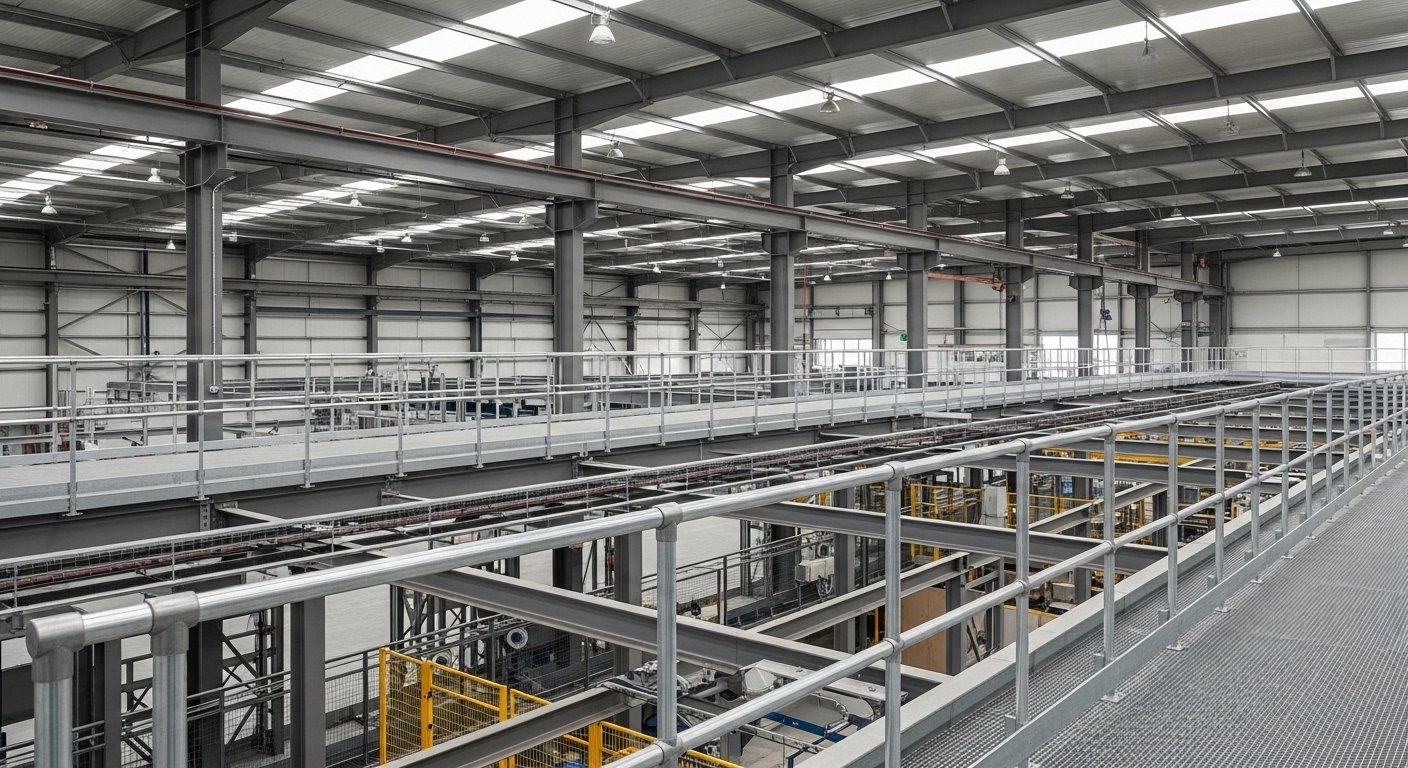
Railings India manufactures commercial industrial safety railing and fall-protection systems from our Hyderabad production facility for EPC contractors, PMC consultants, warehouse developers, process-plant owners, logistics operators and industrial estate occupiers across Telangana. An industrial safety railing is a primary guard and barrier system -- it stops a person or object falling from an open edge at height. That is a different brief from a handrail, which is the continuous grip element occupants hold while moving along a route.
This page is deliberately scoped to fall-protection and guarding systems -- guardrails, platform railings, walkway railings, mezzanine barriers, machine safety fences, loading bay rails, maintenance platform guards, roof-edge protection and coordinated factory/warehouse/process-plant access barriers. It does not cover handrails as grip/support-only systems. Handrails -- wall-mounted corridor rails, ramp grip rails and platform-edge support rails -- are covered on our handrails Hyderabad authority page. Use this page when the BOQ line item is edge guard, barrier or fall protection, not a support rail alone.
It is also distinct from our other Hyderabad pages: staircase railings Hyderabad covers complete stair balustrade assemblies; stainless steel railings Hyderabad covers SS balustrade systems across all applications; glass railings Hyderabad and frameless glass railings Hyderabad cover glass guard engineering for commercial buildings. This page is the Hyderabad reference for industrial guard and barrier scope in warehouse, factory and process-plant BOQs.
For staircase guard assemblies that include both a fall-protection balustrade and an integrated handrail on the same flight, see staircase railings Hyderabad. For balcony-edge guards on commercial and residential buildings rather than industrial platforms, see balcony railings Hyderabad. Height and code context: NBC 2016 railing height requirements.
National product engineering: industrial safety railings, stainless steel railings, CRCA railings, aluminium railings. Capability: manufacturer credentials, projects.
Applications
Industrial safety railing scope varies by building type, process hazard and edge condition. Here are the programmes across India we support most frequently:
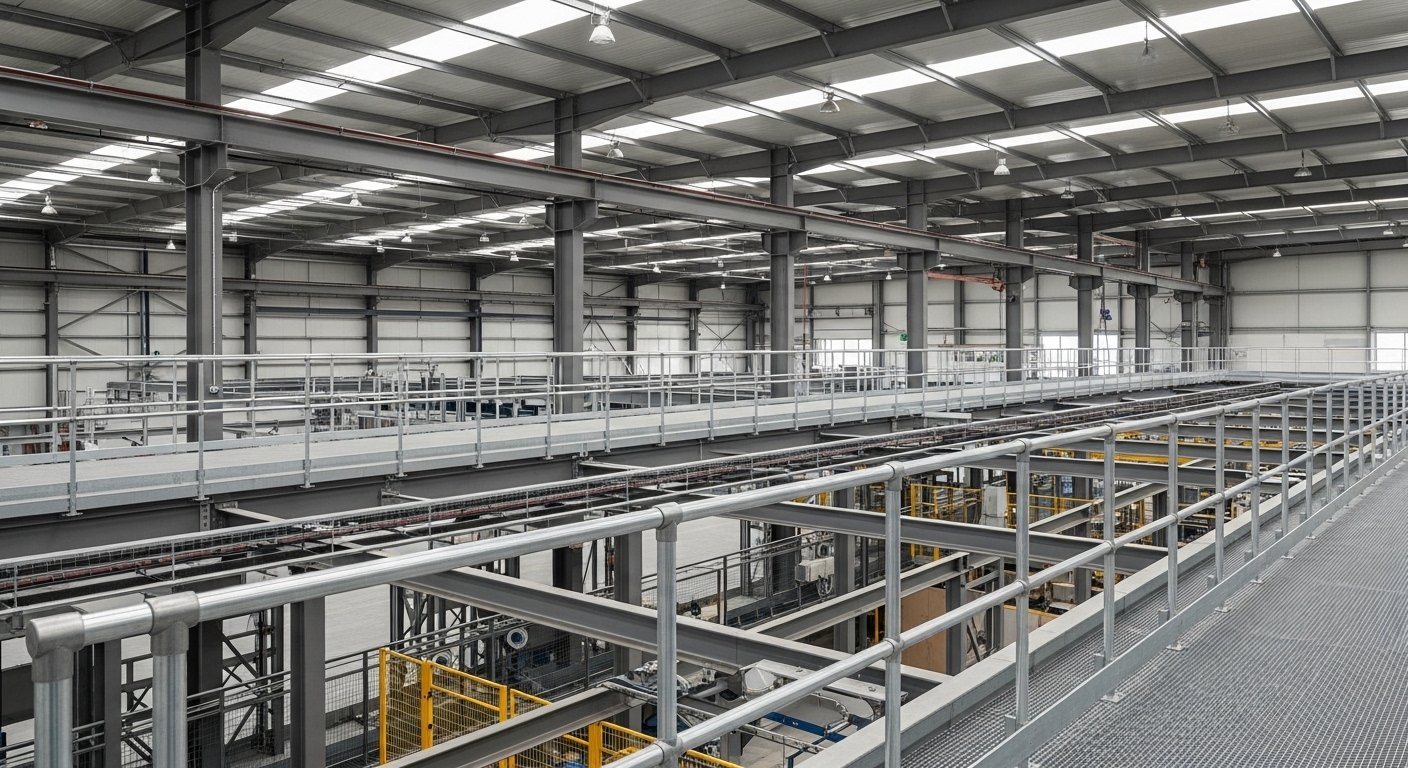
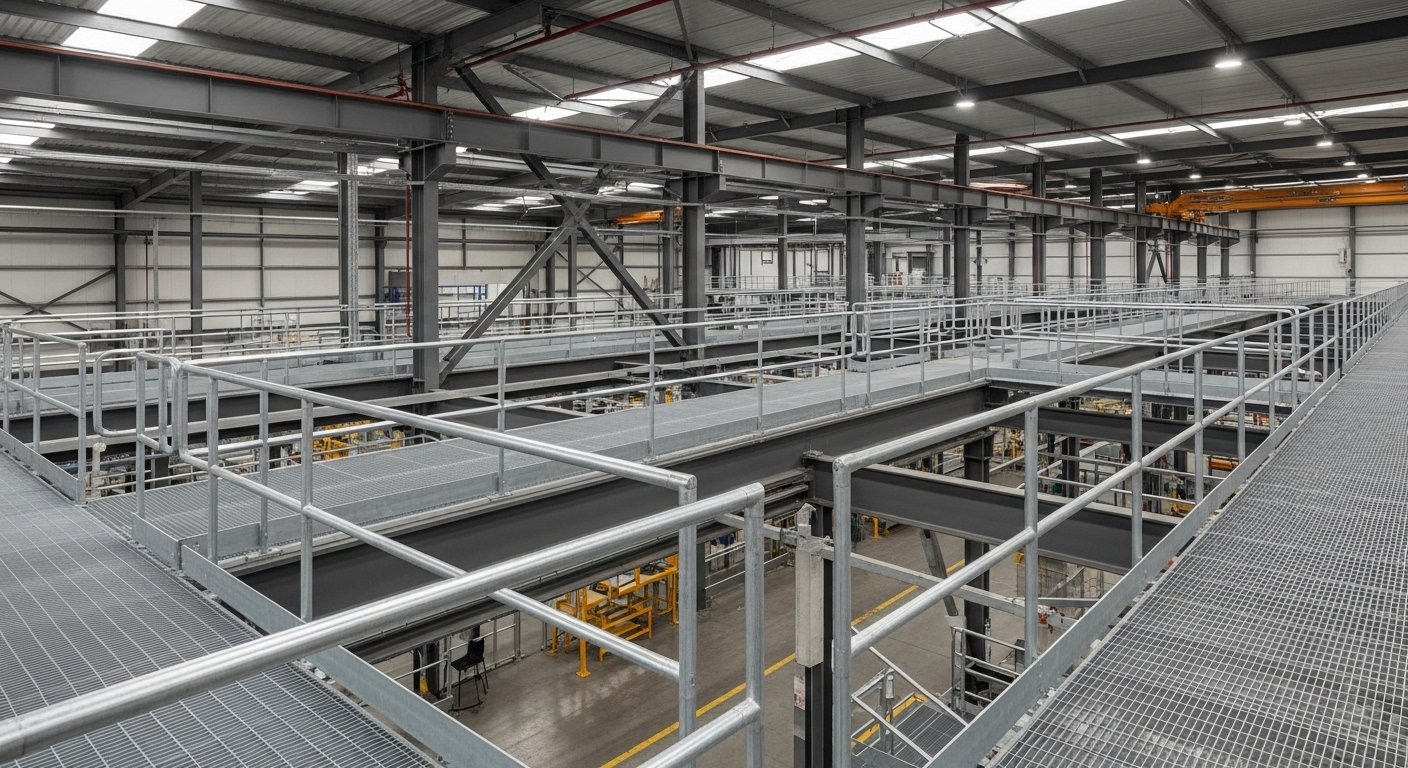
- Warehouse and logistics mezzanines -- perimeter guardrails, pallet-edge gates and conveyor bridge walkway rails across Patancheru, Jeedimetla and ORR distribution sheds.
- Manufacturing and assembly plants -- platform edge guards, aisle-side pit barriers and machine perimeter fencing in factory halls.
- Process and chemical plants -- SS316 walkway rails, tank access platform guards and toeboard-equipped barriers in chemical exposure zones.
- Pharma and food processing -- SS304 platform and walkway guards with wash-down-compatible finishes in hygienic process areas.
- Data centre and IT campus back-of-house -- plant platform guards, roof equipment access rails and loading dock barriers in HITEC City and Financial District campuses.
- Cold chain and industrial refrigeration -- galvanised or SS guards at elevated maintenance decks around plant equipment.
- Automotive and engineering estates -- mezzanine storage guards, press-pit edge barriers and loading bay rails.
- Industrial retrofit and expansion -- added guardrails when mezzanine levels, conveyor bridges or roof plant are introduced into existing sheds.
Why Industrial Safety Railings Matter
Industrial guard and barrier systems carry a life-safety and operational duty that corridor handrails and decorative balustrades do not. On a mezzanine edge or loading bay, the guardrail is the primary system preventing a fall from height:
Procurement teams often receive a single "railing" line item in an early BOQ that mixes guardrail, handrail and stair balustrade scope. Separating fall-protection guards from grip rails at tender stage prevents the wrong system being priced, fabricated and installed -- and avoids costly refabrication when the safety consultant reviews the as-built condition before plant commissioning.
- Primary fall protection at open edges -- guardrails, platform rails and walkway barriers are the first line of defence at mezzanine perimeters, roof edges and loading platforms.
- Dropped-object control -- toeboards at guard bases prevent tools, fasteners and pallet components falling to lower levels in active plants.
- Machine hazard isolation -- fixed barriers and interlocked gates keep operators out of hazardous machine zones during operation.
- Regulatory and client audit readiness -- guard height, opening size and load intent documented on shop drawings support PMC, EPC and client safety audits.
- Operational continuity -- robust HDG or SS guards withstand the bump environment of forklifts, pallet movement and daily plant traffic with correct detailing.
- Insurance and liability context -- documented guard specification and installation records form part of the plant safety file for many industrial occupiers.
Industrial Safety Railing Types -- Overview
We manufacture industrial safety railing and fall-protection systems from our Hyderabad production facility across guardrail, platform, walkway, mezzanine, machine barrier, loading bay, maintenance platform, roof-edge, factory/warehouse and process-plant families. Material choice (MS, CRCA, HDG, SS304, SS316) follows environment and corrosion brief rather than being a separate product line:
Primary edge barriers at platform, roof and loading bay perimeters.
Modular bay guard systems for warehouse and factory elevated floors.
Catwalk, bridge and gantry route edge protection.
Fixed guards and interlocked gates around process equipment.
Dock-edge and elevated loading platform guards.
Permanent edge protection for maintenance access routes.
Guardrails
Guardrails are the primary fall-protection barrier at an open edge -- platform perimeters, roof access routes, loading dock edges and elevated walkway sides. A guardrail assembly typically comprises posts at approved centres, a top rail, an intermediate rail (or infill panel) and, where specified, a toeboard at the base.
warehouse and factory programmes most often specify guardrails in hot-dip galvanised mild steel for external and semi-exposed edges, or painted MS/CRCA for internal mezzanine perimeters. Stainless steel guardrails are used where hygiene, chemical resistance or premium durability is required.
On multi-level warehouse programmes, guardrail scope often splits into internal mezzanine bays (painted MS) and external loading or roof-access bays (HDG) within one PO -- we tag and phase dispatch accordingly so the correct coating system reaches the correct zone without site mixing.
- Post centres -- set against span, load case and infill type on the approved drawing, not a single universal spacing.
- Infill options -- horizontal tube rails, mesh panel, solid kick-plate lower section or combined tube-and-mesh for machine-adjacent zones.
- Gate sections -- self-closing or interlocked gates at ladder landings, forklift crossings and maintenance access points.
- Fixing -- base-plate bolt-down to steel mezzanine deck or cast-in/expansion anchors to concrete slab edge -- confirmed with the structural engineer.
- Common environments -- warehouse mezzanine perimeters, factory floor edges, roof plant access and loading bay sides.
National industrial safety railing engineering: industrial-safety-railings.
Platform Railings
Platform railings guard the open sides of elevated work platforms, equipment access decks, conveyor service platforms and maintenance landings. They are specified as a complete barrier system rather than a grip rail alone.
On Hyderabad industrial estates, platform railing packages are commonly phased with mezzanine steel erection -- guardrail bays prefabricated to modular lengths for repeat fixing along straight runs and standard corner conditions.
Platform railing programmes in Hyderabad frequently run alongside racking installation: we coordinate post positions with the rack aisle layout drawing so guard bays do not conflict with pallet overhang zones or VNA truck paths shown on the logistics plan.
- Modular bay fabrication -- repeat post-and-rail bays fabricated to drawing length for faster site assembly along long platform runs.
- Toeboard coordination -- kick plates integrated at the base where the platform safety brief requires dropped-object protection.
- Load path -- post and base-plate fixings detailed to the platform structural drawing and any specified horizontal load case.
- Material -- MS/HDG for warehouse and logistics platforms; SS304/316 for food, pharma and chemical-adjacent decks.
- Handoff to handrails -- where a wall-adjacent platform also needs a continuous grip rail, that support-rail scope is on our handrails Hyderabad page.
Walkway Railings
Walkway railings protect elevated pedestrian routes between plant areas, across mezzanine bridges, along catwalks and at external gantry walkways. The guard must be continuous along the open side of the route with transitions at changes of direction and level.
Exposed exterior walkways typically specify hot-dip galvanised or SS316 systems with fixings assessed under IS 875 (Part 3) for that structure's exposure -- confirmed by the project structural engineer, not a fixed city wind assumption.
Catwalk and gantry walkway guards on process plants often require removable sections at pipe bridge crossings -- these are detailed as keyed or bolted panel sets on the shop drawing rather than field-cut on site, preserving coating integrity at the joint.
- Continuous run detailing -- rails fabricated in manageable lengths with bolted splice joints at approved locations.
- Stair and ladder interfaces -- guardrail terminates or transfers at stair top landings and fixed-ladder upper guards per the approved layout.
- Width coordination -- post placement respects minimum clear walkway width on the approved drawing.
- Environment -- internal dry catwalks vs external gantry or roof-linked walkways drive coating and grade selection.
Mezzanine Railings
Mezzanine railings guard the open edges of intermediate floor levels in warehouses, distribution centres and manufacturing plants -- often the highest-metre-count guardrail scope in a Hyderabad logistics project.
Guard height, opening limitations and any toeboard requirement follow NBC 2016 and the project's approved mezzanine safety drawing. We detail post bases for fixing to the mezzanine steel edge beam or slab penetration as shown structurally.
For double-tier mezzanine warehouses, upper and lower edge guards may use different materials -- HDG at the ground-level loading edge and painted MS at the upper storage tier -- quoted as separate line items in the same commercial proposal for procurement clarity.
- Repeat bay economics -- long straight mezzanine edges benefit from modular bay fabrication and phased dispatch aligned to mezzanine handover.
- Gate bays at pallet drops -- removable or hinged gate sections at goods lifts and pallet edge zones where the layout requires intermittent access.
- Pallet guard coordination -- guardrail height and rail spacing checked against the client's rack and pallet overhang assumptions on the drawing.
- Material default -- painted MS or HDG for standard warehouse mezzanines; SS for clean-room or food-adjacent mezzanine levels.
Machine Safety Barriers
Machine safety barriers are fixed guard panels, perimeter fences and interlocked gate sections that prevent access to hazardous machine zones during operation. They sit within the broader industrial safety railing family but are detailed against machine layout and safety category rather than a generic platform edge.
Panel infill may be mesh, solid steel sheet or tube rail depending on the hazard type (moving parts, pinch points, ejected material). Gate interlocks and hold-open devices are specified only where the approved safety layout requires them.
Machine barrier scope is typically released after equipment placement sign-off: we prefer an approved layout with machine centre lines marked before fabrication freeze, because guard panels must clear maintenance hatches and conveyor transfer points shown on the OEM drawing.
- Layout-driven fabrication -- barrier runs follow the machine footprint on the approved safety layout, not a standard modular grid.
- Access gates -- hinged or sliding gates at operator service points; interlock hardware when specified by the safety consultant.
- Fixed vs removable sections -- some maintenance zones specify removable guard panels for periodic equipment lift-out.
- Finish -- yellow/black safety paint or galvanised finish per client plant standard.
Loading Bay Railings
Loading bay railings guard dock edges, elevated loading platforms and forklift approach sides where a fall from height or vehicle interface hazard exists. They must withstand the bump and snagging environment of active logistics operations.
Hot-dip galvanised MS is the common default for warehouse loading bays -- durable against weather at partially open dock faces and resistant to minor impact with correct post and base-plate detailing.
Dock leveller pits and overhead door tracks frequently dictate guardrail stop/start points at loading bays -- a site survey against the approved dock section drawing prevents rework when the door track or bumper location differs from the GA assumption.
- Dock edge continuity -- guard runs coordinated with dock leveller pits, bumpers and overhead door tracks.
- Impact resilience -- heavier post sections and reinforced base plates at high-traffic corners.
- Removable sections -- where occasional oversize load entry requires a demountable guard bay.
- Weather exposure -- HDG or SS316 for semi-open and external loading contexts.
Maintenance Platform Railings
Maintenance platform railings guard permanent or semi-permanent access decks around plant equipment, HVAC plant, silos, tanks and roof-mounted services. They are specified for technician access during inspection and service rather than general circulation.
Fixings are coordinated with the platform structural frame and any insulation or cladding build-up so that the guard does not compromise equipment access panels shown on the layout.
Roof-mounted HVAC and cooling-tower maintenance decks in HITEC City and Financial District campuses often combine permanent guard with a demountable end bay for equipment change-out -- both conditions are detailed on one shop drawing sheet set.
- Equipment clearance -- rail geometry checked against maintenance hatches, valve handwheels and lift-out paths.
- Demountable options -- some roof and plant platforms specify demountable guard sections for crane lift access.
- Material -- HDG MS or SS316 for exterior plant decks; SS304 for internal plant rooms.
- Drawing-led scope -- each platform guard is laid out against the equipment GA, not a catalogue module.
Roof Safety Railings
Roof safety railings provide permanent or temporary edge protection for flat or low-slope industrial roofs where maintenance access is required. They are among the most exposure-sensitive industrial guard systems and demand careful coordination with waterproofing and structural fixings.
Material is typically hot-dip galvanised MS or SS316. Fixings must be detailed with the roof structural engineer and waterproofing contractor -- we do not specify roof penetrations independently of the approved roof build-up drawing.
Roof guard programmes require early coordination with the roofing contractor: non-penetrative clamp systems and penetrating base-plate systems are not interchangeable mid-programme, so the fixing family is locked at drawing approval before either trade proceeds.
- Edge protection continuity -- guard runs at roof perimeter and around roof-light exclusion zones as shown.
- Non-penetrative options -- clamp-to-parapet or weighted base systems where the drawing calls for zero membrane penetration.
- Wind exposure -- fixings assessed under IS 875 (Part 3) for that roof height and exposure, confirmed by the project SE.
- Access integration -- guards at ladder top exits and plant walkway transitions.
Factory & Warehouse Safety Railings
Factory and warehouse safety railings cover the combined guard scope across production floor edges, aisle-side pits, conveyor gaps, mezzanine perimeters and internal bridges within a single industrial building.
Hyderabad's warehouse and logistics pipeline -- from HITEC City campus back-of-house platforms to Patancheru and Jeedimetla distribution sheds -- typically packages guardrails in MS or HDG with phased release aligned to mezzanine and racking installation.
Large distribution sheds may combine three guard types in one BOQ -- mezzanine edge, conveyor bridge and dock edge -- with a common post section but different infill and coating per zone; modular bay tagging keeps site installation organised across phased handover.
- Multi-zone programmes -- one BOQ may combine mezzanine edge, conveyor bridge and loading bay guards with consistent post/rail section.
- Pallet and rack coordination -- guard height and rail spacing checked against storage layout assumptions.
- Internal vs external bays -- coating system varies by bay even within one building.
- Value engineering -- modular repeat bays and standard corner details reduce cost on long straight runs.
Process Plant Railings
Process plant railings guard elevated access around reactors, tanks, pipe racks, cooling towers and chemical handling zones. Material grade and finish follow the plant corrosion brief -- SS316 is common in chemical exposure areas; HDG MS in general process walkways.
Guard design respects pipe crossings, valve access and instrument panels on the approved P&ID-adjacent layout drawing. Toeboards are frequently specified to prevent small tools falling into process areas below.
Chemical and pharma process areas often reference a client corrosion matrix alongside NBC guard requirements -- SS316 at solvent-handling decks and SS304 at general access walkways within the same plant is a common split we quote transparently.
- Corrosion class -- SS316, duplex or coated MS selected against the chemical exposure matrix on the drawing.
- Toeboards -- standard inclusion where dropped-object protection is part of the plant safety case.
- Removable panels -- at equipment lift-out and manway access points.
- Coordination -- guard offsets checked against pipe insulation and cable-tray routes.
Industrial Access Systems
Industrial access systems combine guardrails with stairs, fixed ladders, crossover bridges and maintenance walkways into a coordinated fall-protection package. While stair balustrade assemblies are detailed on our staircase railings Hyderabad page, the platform-edge and walkway guard components of an access system belong here.
A complete access package might include a fixed ladder with upper exit guard, a mezzanine bridge with walkway railings and a roof maintenance route with edge protection -- each element detailed to the same post/rail section family for visual and procurement consistency.
Crossover bridges between conveyor lines and fixed-ladder upper guards share post/rail sections for procurement efficiency, but each element is detailed on its own shop drawing sheet because fixing substrates differ (steel bridge deck vs concrete pad vs roof build-up).
- Cross-system consistency -- common post section and finish across ladder guards, bridges and platform edges.
- Stair vs guard scope line -- stair flight balustrades on staircase page; platform and bridge guards on this page.
- Modular delivery -- prefabricated ladder cage and bridge guard bays dispatched in install sequence.
- Compliance -- each element confirmed against the approved access and safety drawing set.
Technical Specification Table
Indicative commercial matrix across industrial safety railing material families. Project-specific values confirmed on calculations and approved shop drawings before fabrication freeze.
| Material | Grade | Finish | Fixing Method | Application | Environment | Maintenance | Compliance |
|---|---|---|---|---|---|---|---|
| MS / CRCA guardrail | CRCA / IS 2062 mild steel (typical) | Epoxy/zinc-rich primer + PU topcoat (typical industrial system) | Base-plate bolt-down to steel deck or anchor to concrete edge | Internal mezzanine, factory floor edges, conveyor bridges | Dry internal warehouse/factory | Periodic coating inspection; touch-up at impact points | NBC 2016 guard (drawing); IS 875 Part 5 loads (project SE) |
| Hot-dip galvanised (HDG) guardrail | MS substrate; galvanising per project spec | Hot-dip zinc coating (coating weight per drawing) | Base-plate bolt-down; heavy-duty anchors at dock edges | Loading bays, external walkways, roof-edge routes | Semi-exposed / external industrial | Low routine maintenance; inspect after impact events | NBC 2016 guard (drawing); IS 875 Part 3 wind (project SE, if exposed) |
| SS304 industrial guardrail | SS304 tube and plate (typical) | Satin (brushed) or 2B mill finish | Base-plate or side-mount to steel; chemical anchors to concrete | Food/pharma platforms, clean process walkways | Wash-down / hygienic internal zones | Wash-compatible; avoid chloride cleaners | NBC 2016 guard (drawing); client hygiene standard |
| SS316 industrial guardrail | SS316 tube and plate (typical) | Satin or electropolished (selective) | Base-plate bolt-down; non-penetrative roof clamp where specified | Chemical plant decks, external roof routes, aggressive exposure | Chemical / marine / external industrial | Wash-down compatible; inspect fixings in corrosive atmospheres | NBC 2016 guard (drawing); IS 875 Part 3 (project SE, if exposed) |
Materials Guide
Decision guide for procurement teams comparing industrial guardrail materials on the same Hyderabad plant or warehouse:
| Material | Best for | Avoid when |
|---|---|---|
| Painted MS/CRCA | Internal mezzanine and factory guards; budget-sensitive long runs | Semi-open loading bays and external routes without enhanced coating |
| Hot-dip galvanised MS | Loading bays, external walkways, roof-edge routes | Aggressive chemical wash-down without additional protection |
| SS304 | Food, pharma and clean internal process platforms | Heavy chemical/chloride external exposure |
| SS316 | Chemical plants, external roof routes, coastal-industrial exposure | Dry internal warehouse where HDG or painted MS suffices |
CRCA and mild steel railing detail: CRCA railings. Stainless systems: stainless steel railings.
Surface Finishes
- Industrial paint system (MS/CRCA) -- blast or mechanical prep, zinc-rich primer and PU/epoxy topcoat to the project's DFT specification. Yellow/black safety marking where the plant standard requires.
- Hot-dip galvanising -- post-fabrication dip for long-life corrosion protection on external and semi-exposed guards. Touch-up at cut edges and weld zones per galvanising practice.
- SS satin (brushed) -- default low-glare finish for SS304/316 process-area guards subject to hand contact and wash-down.
- SS electropolish (selective) -- specified for premium pharma or clean-room contexts where surface roughness matters.
- Dual-coat HDG + paint -- duplex systems where extended life or colour coding is required on external industrial guards.
Manufacturing Process
Industrial safety railing fabrication at our Hyderabad production facility follows a drawing-led sequence:
- Drawing take-off -- running-metre quantities, post counts, gate bays and toeboard lengths from approved layouts.
- Material release -- MS/CRCA, HDG-ready steel or SS tube and plate to grade confirmed on the PO.
- Cut and weld -- post, rail and panel frames fabricated; base plates and gussets welded per shop drawing.
- Coating or galvanising -- paint system applied pre-assembly where practical; HDG dip after fabrication for galvanised orders.
- Modular bay assembly -- repeat guard bays pre-assembled for straight runs; corner and gate bays separately kitted.
- QC and dispatch -- dimensional check, coating film check and bay labelling before phased dispatch to site.
Quality Control
Quality control on industrial guardrail orders focuses on dimensional accuracy, coating integrity and drawing conformance:
- Incoming material check -- grade and section size against PO and drawing.
- Weld and fit-up inspection -- post plumb, rail level and squareness of modular bays.
- Coating DFT check -- dry film thickness on painted systems per project spec.
- Galvanising appearance -- visual check for bare spots and drip consistency; touch-up kit supplied for site cuts where applicable.
- Dimensional release -- bay length and post centres checked against approved shop drawing before dispatch.
- Documentation -- shop drawing revision record and dispatch note for PMC close-out.
Advantages -- Why Builders Across India Choose Railings India
- Local manufacturing base -- industrial guardrail packages coordinated from our Hyderabad production facility across MS, HDG and SS families.
- Fall-protection scope depth -- dedicated attention to guardrails, mezzanine barriers, machine fences and loading bay rails rather than treating industrial scope as a generic railing line item.
- Clear scope line vs handrails -- this page and our handrails Hyderabad page together cover the two distinct BOQ categories without overlap or confusion.
- Material comparison in one enquiry -- MS, HDG and SS options quoted side-by-side against the same platform layout.
- Industrial estate familiarity -- repeat programmes across Patancheru, Jeedimetla and ORR logistics corridors.
- Documentation discipline -- NBC 2016 and IS 875 references, shop drawings and BOQ review for commercial industrial orders.
Procurement Support
Structured support for EPC contractors, PMC consultants and procurement teams evaluating industrial safety railing packages:
- BOQ review -- material grade, post spacing, toeboard inclusion, gate hardware and fixing assumptions checked against the tender document.
- Quantity estimation -- running-metre and post counts derived from mezzanine GA, platform layout or walkway plan drawings.
- Material selection -- MS vs HDG vs SS304 vs SS316 guidance by environment, exposure and maintenance brief.
- Engineering consultation -- guard height, load intent and wind exposure (where relevant) discussion against the project's structural and safety drawings.
- Shop drawings -- DWG/PDF issued for approval before fabrication freeze, including gate, toeboard and corner bay details.
- Tender support -- clarifications and technically-equivalent alternates where value engineering is invited.
- Value engineering -- modular bay design, material substitution and repeat-corner standardisation that reduce cost while protecting safety intent.
- Commercial documentation -- quotations, purchase-order formats and delivery schedules aligned to PMC procurement workflow.
Project Workflow
- Enquiry -- share mezzanine GA, platform layouts or walkway plans and preferred material family (or ask us to compare MS, HDG and SS against your corrosion brief).
- Technical review -- application, environment, toeboard/gate requirements and load intent assessed against the brief.
- Commercial proposal -- clarified inclusions/exclusions for supply.
- Shop drawing approval -- post centres, bay lengths, fixings and finish locked before fabrication freeze.
- Fabrication & dispatch -- manufactured and phased to mezzanine/platform handover readiness, including galvanising queue where applicable.
- Handover pack -- drawings and documentation for PMC and client safety file close-out on commercial orders.
Installation
Installation sequencing depends on substrate type (steel mezzanine deck, concrete edge or roof build-up), coating condition and adjoining trades:
- Survey the platform edge, walkway run or loading bay line against the approved shop drawing before fixing; confirm substrate level and anchor edge distances.
- Set base plates or floor fixings at approved post centres; torque anchors to specification.
- Erect posts, fit top and intermediate rails or infill panels, install toeboards and gate hardware.
- Coordinate with mezzanine steel erector, roofing contractor and safety consultant for sequencing at roof and dock interfaces.
- Final inspection, touch-up of coating at field welds or cuts, and handover to client safety team.
Maintenance
- Painted MS guards -- periodic visual inspection of coating at impact points, forklift zones and external transitions; touch-up per paint system data sheet.
- Hot-dip galvanised guards -- low routine maintenance; inspect after significant impact; touch-up zinc-rich paint at damaged areas.
- Stainless steel guards -- wash-compatible cleaning in process areas; avoid chloride-based cleaners; inspect fixings in corrosive atmospheres.
- Gate and interlock hardware -- exercise hinges and interlocks on planned maintenance cycles; replace worn latch components promptly.
- Toeboards -- inspect for deformation or detachment after pallet impacts at mezzanine edges.
- Impact events -- isolate and assess any guard bay involved in a forklift or load impact before returning to service.
Industries We Serve
Each industry brings different code, hygiene, load and finish priorities. BOQ review and shop drawings confirm the correct system family before fabrication for programmes across India.
Cities We Serve
Railings India fabricates and supplies railing systems for commercial, institutional and industrial programmes across India. Project teams in major metros and growth cities typically engage us for BOQ review, material selection, shop drawings and factory fabrication before site installation.
Cities we regularly support include Hyderabad, Bengaluru, Chennai, Mumbai, Pune, Delhi NCR, Ahmedabad, Surat, Jaipur, Lucknow, Kolkata, Vijayawada, Visakhapatnam, Kochi, Coimbatore and Nagpur -- along with satellite towns and industrial corridors serving those metros.
Nationwide supply does not imply a local branch in every city. Engineering consultation, documentation and fabrication are coordinated from our Hyderabad production facility, with dispatch and installation support aligned to each project's programme.
States We Serve
- Telangana -- Hyderabad and surrounding industrial / IT corridors.
- Andhra Pradesh -- Vijayawada, Visakhapatnam and coastal / inland commercial programmes.
- Karnataka -- Bengaluru and adjoining industrial belts.
- Tamil Nadu -- Chennai, Coimbatore and institutional campuses.
- Kerala -- Kochi and commercial hospitality corridors.
- Maharashtra -- Mumbai, Pune, Nagpur and western industrial estates.
- Gujarat -- Ahmedabad, Surat and manufacturing hubs.
- Odisha / West Bengal -- Bhubaneswar corridor and Kolkata commercial programmes as project schedules require.
- Delhi NCR -- Delhi, Gurugram, Noida and adjoining institutional / commercial packages.
State coverage is demand-led. We do not claim warehouses or sales offices in every state -- only factory-backed supply and documentation for awarded programmes.
Nationwide Manufacturing & Supply
Railings India manufactures railing and related architectural metal / glass systems from our Hyderabad production facility for projects across India. We do not claim a branch network in every city -- we claim factory fabrication, engineering documentation and coordinated supply against approved drawings.
In-house cutting, welding, finishing and assembly to approved shop drawings.
Line-item review before order release to reduce site variation.
System selection against NBC 2016 and IS requirements confirmed on project drawings.
Fabrication and fixing drawings for PMC / consultant approval.
Glass, SS, aluminium, MS/HDG and hybrid packages matched to environment.
In-process checks before dispatch, with independent lab testing arranged where a project specifies it.
Dispatch and phased delivery aligned to contractor programmes across India.
Sequencing with civil, facade and interior trades on multi-block sites.
Quotations, schedules and handover packs for EPC / PMC procurement files.
FAQs -- Industrial Safety Railing Manufacturer Hyderabad
1. Who manufactures industrial safety railings in Hyderabad?
Railings India manufactures commercial industrial safety railing and fall-protection systems from our Hyderabad production facility for EPC contractors, PMC consultants, warehouse developers, process-plant owners, logistics operators and industrial estate occupiers across Telangana.
2. What is the difference between industrial safety railings and handrails?
Industrial safety railings are primary fall-protection and guarding systems -- guardrails, platform edge barriers, walkway rails and machine fences that stop a person or object falling from height. Handrails are continuous grip and support elements occupants hold while moving. A platform may need both: a guardrail at the open edge and a handrail along an adjacent wall. Handrails are covered on our handrails Hyderabad page; this page covers edge-guard and barrier systems only.
3. MS or stainless steel for industrial guardrails in Hyderabad?
Mild steel with a durable coating (painted or hot-dip galvanised) is the common default for internal warehouse and factory guardrails where budget and repeat bay fabrication matter. SS304 suits cleaner internal process areas and food-adjacent zones. SS316 is specified for chemical exposure, aggressive wash-down or external roof-edge and loading-bay environments. Grade selection is confirmed against the project's corrosion brief and maintenance plan.
4. Do you supply toeboards with platform and walkway guardrails?
Yes, where the approved drawing or plant safety standard calls for them. Toeboards (kick plates) at the base of a guardrail prevent tools, pallets and small objects rolling off a platform edge. Height, fixing detail and continuity at gates or ladder openings are confirmed on shop drawings before fabrication.
5. What guardrail height applies to mezzanine platforms?
Mezzanine and elevated platform guardrail height follows NBC 2016 and the project's approved structural and safety drawings for that occupancy and edge condition. We do not apply a single fixed height to every mezzanine -- the dimension is confirmed against the approved drawing, load case and any client plant-safety standard referenced in the tender.
6. How are guardrail loads assessed for industrial structures?
Horizontal and vertical load cases on guardrails, posts and fixings are assessed project-by-project. Where the project structural engineer specifies a load framework, it is typically aligned with IS 875 (Part 5) guard loads or the client's own plant standard. We detail fixings and post centres to the approved calculation or drawing -- not a generic assumption applied to every Hyderabad industrial package.
7. Hot-dip galvanised or painted MS for warehouse guardrails?
Hot-dip galvanised (HDG) MS is preferred for exposed loading bays, external walkways and roof-edge contexts where long-term corrosion resistance with minimal touch-up is needed. Painted MS with an industrial coating system suits many internal warehouse and mezzanine applications where the environment is dry and maintenance access is straightforward. The choice is confirmed against exposure, budget and the project's maintenance plan.
8. Do you supply machine safety barriers and fencing?
Yes. Machine safety barriers -- fixed guard panels, interlocked gate sections and perimeter fencing around process equipment -- are supplied as part of the industrial safety railing scope when shown on the approved layout. Panel infill (mesh, solid plate or tube) and gate hardware are detailed to the machine OEM or safety consultant's drawing.
9. Can you supply roof-edge safety railings in Hyderabad?
Yes, for flat or low-slope industrial roof perimeters, plant access routes and maintenance walkways where the approved drawing calls for a permanent or demountable guard. Material is typically hot-dip galvanised MS or SS316 for weather exposure. Fixings are coordinated with the roof waterproofing and structural engineer -- not specified independently of the roof build-up.
10. Do you supply industrial safety railings to Patancheru and Jeedimetla estates?
Yes. Patancheru and Jeedimetla industrial estates are a core supply corridor for our Hyderabad industrial programmes -- warehouse mezzanine guardrails, factory platform barriers, loading bay rails and process-area fencing are commonly phased to fit-out and plant commissioning schedules across these ORR industrial pockets.
11. Can you review our BOQ for industrial guardrail scope?
Yes. Share the tender BOQ or layout drawings via Get a Quote. We check material grade, post spacing, toeboard inclusion, gate hardware, fixing assumptions and missing accessory line items against the intended application before commercial proposal.
12. What lead time should we plan for industrial guardrail fabrication?
Lead time depends on total running metres, material grade, coating type, gate/interlock hardware and drawing approval cycle. We confirm a programme-specific schedule after shop drawing approval and material release -- we do not publish a fixed day count that may not apply to your order volume or coating queue.
13. What NBC 2016 requirements apply to industrial guardrails?
NBC 2016 guard and barrier provisions apply by occupancy and edge condition as shown on the approved drawings. Height, opening limitations and load intent are confirmed against the project's code edition and safety brief -- not assumed from a generic commercial-building reference when the structure is a warehouse, plant or mezzanine.
14. How are industrial safety railings installed on site?
Installation follows the approved shop drawing: survey the platform edge or walkway run, set base plates or floor fixings, erect posts at approved centres, fit rails and infill panels, install toeboards and gates, then torque and inspect fixings before handover to the client's safety team. Sequencing is coordinated with slab, mezzanine steel and MEP trades.
15. How do I start a Hyderabad industrial safety railing enquiry?
Share layout drawings, mezzanine GA or a BOQ via Get a Quote or Contact Us. Note application (warehouse, process plant, loading bay, roof edge), preferred material (MS/HDG/SS) and whether you need BOQ review, shop drawings or a fresh commercial proposal.
Related Products
Downloads Available On Request
Available on request for qualified commercial enquiries -- not published as placeholder PDFs:
- Typical industrial guardrail detail sheets by material family (after scope confirmation)
- Material selection notes (MS vs HDG vs SS304 vs SS316 for industrial guards)
- Shop drawing title-block samples including gate, toeboard and corner bay details
- Coating and galvanising maintenance guidance by material
- Company capability statement via manufacturer credentials
Commercial CTA -- India Industrial Safety Railing Enquiry
Share your Hyderabad mezzanine GA, platform layouts or walkway plans for industrial guardrail and fall-protection packages -- guardrails, platform rails, machine barriers and loading bay systems in MS, HDG and SS. We respond with material comparison, a BOQ review and a commercial proposal suitable for EPC and PMC review.
Get a QuoteContact Us