Product Overview
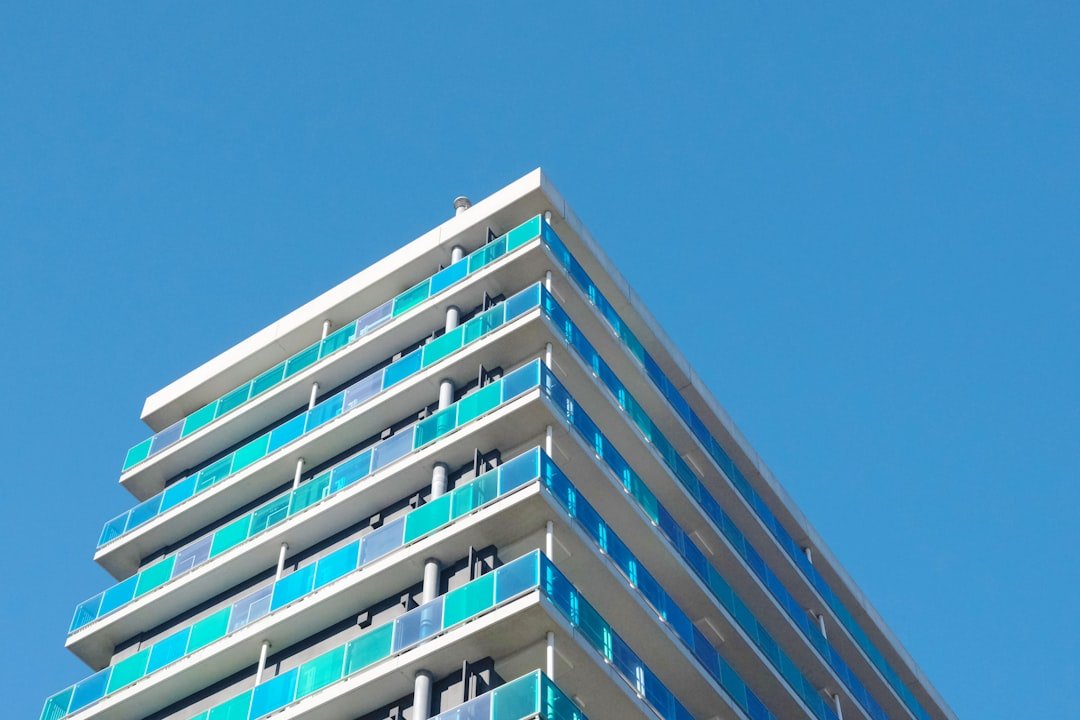
Railings India fabricates commercial frameless glass railing systems from our Hyderabad production facility for B2B buyers who need clear sightlines without sacrificing guard compliance. Scope covers balcony edges, staircase voids, atrium openings, podium decks and terrace packages using continuous base shoes, point-fixed spigots, standoff assemblies and channel profiles -- paired with toughened or laminated safety glass selected for the project's load and fragment-retention brief.
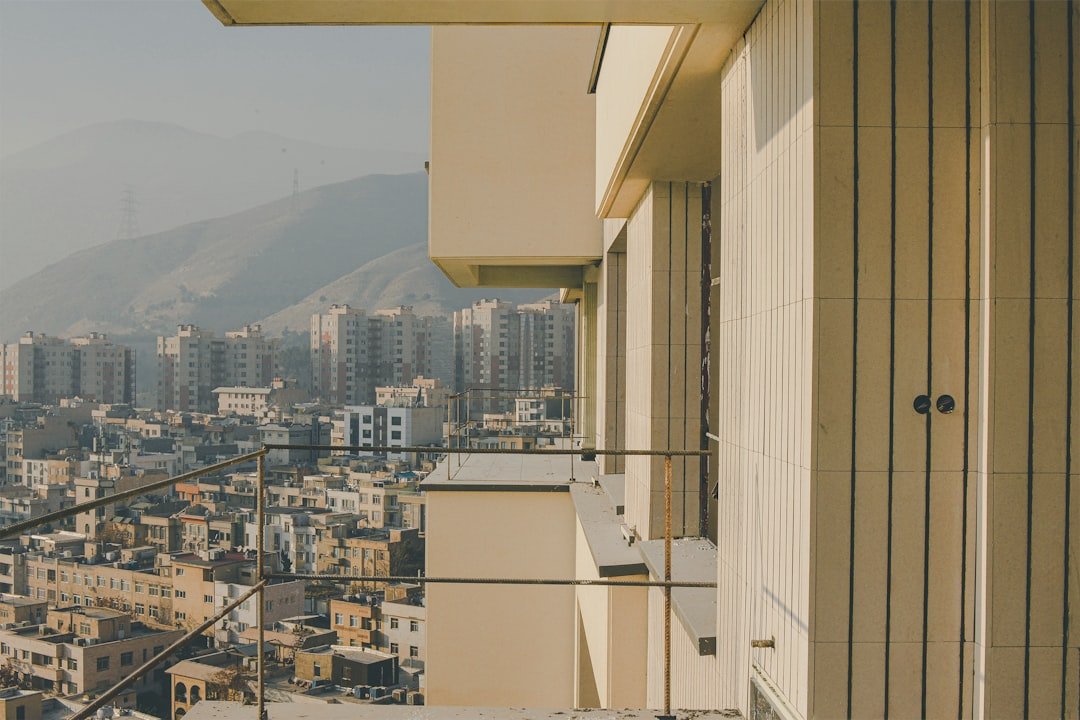
Hyderabad's west-corridor towers and hospitality shells increasingly specify frameless edges where marketing views and consultant aesthetics matter. Those packages still need wind-aware detailing for IS 875 (Part 3) project-specific design . This page is the Hyderabad city authority for frameless systems -- complementary to our broader glass railings Hyderabad page and distinct from metal-primary stainless steel railings Hyderabad.
National system engineering lives on frameless glass railing system, with dedicated deep-dives for base shoe and spigot families. Capability and portfolio context: manufacturer credentials and projects.
Why Frameless Glass Railings
Frameless does not mean structure-free. It means the glass becomes the visible plane while hardware is pushed to the slab edge, stringer or side face. commercial teams choose frameless when:
- View is a sales asset -- west-facing balconies and amenity decks where posts would interrupt the skyline.
- Architects want continuous glass lines -- repeated floor plates with consistent edge details across towers.
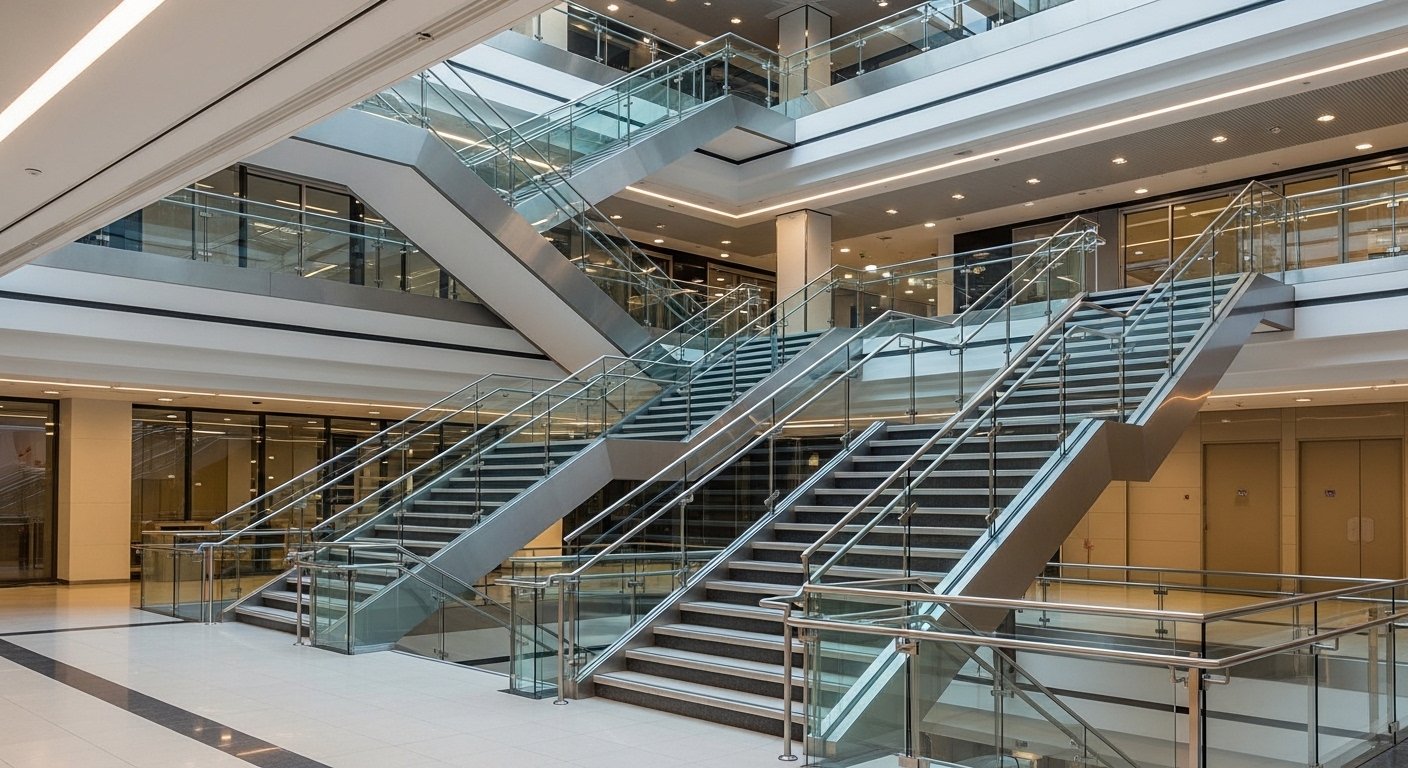
- Interior voids need light -- atriums and feature stairs where metal balustrades feel heavy.
- Hybrid campuses need both metal and glass -- SS cores for traffic, frameless edges for amenity and sellable faades.
- Consultants can lock a fixing family early -- base shoe for long runs; spigot for point-fixed prestige edges; channel or standoff where slab geometry demands it.
Applications
- Balcony and terrace edges -- high-rise residential and mixed-use sell faces. See also balcony railings.
- Staircase and landing voids -- feature stairs in lobbies and office cores. See staircase railings.
- Atrium and mezzanine openings -- multi-level commercial interiors.
- Podium and amenity decks -- hospitality and residential club levels.
- Pool-adjacent decks -- laminated glass and corrosion-aware hardware selection required; grade confirmed per exposure.
- Corridor and gallery edges -- where transparency supports wayfinding and daylight.
Industries Served
Sector wording only -- no unverified project names:
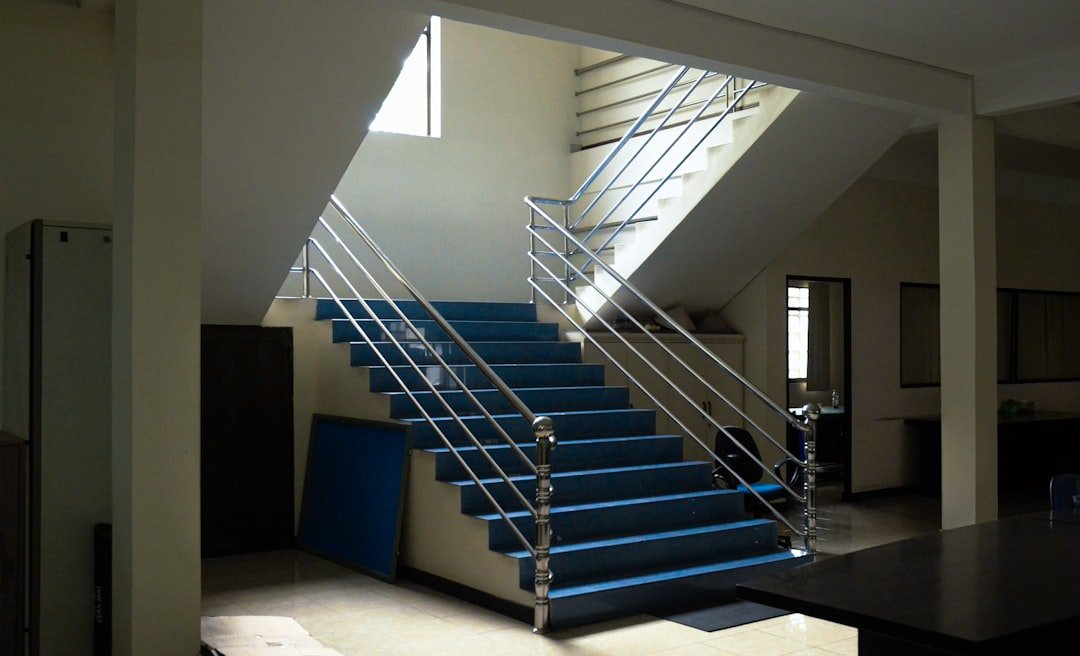
Atrium voids, terrace edges, lobby stairs.
Repeat balcony plates and podium decks.
Feature stairs, gallery edges, amenity decks.
Daylit voids where metal guards feel institutional.
Slab-edge frameless runs coordinated to faade modules.
Fit-out stair and void packages with shop-drawing lock.
Industries We Serve
Each industry brings different code, hygiene, load and finish priorities. BOQ review and shop drawings confirm the correct system family before fabrication for programmes across India.
Cities We Serve
Railings India fabricates and supplies railing systems for commercial, institutional and industrial programmes across India. Project teams in major metros and growth cities typically engage us for BOQ review, material selection, shop drawings and factory fabrication before site installation.
Cities we regularly support include Hyderabad, Bengaluru, Chennai, Mumbai, Pune, Delhi NCR, Ahmedabad, Surat, Jaipur, Lucknow, Kolkata, Vijayawada, Visakhapatnam, Kochi, Coimbatore and Nagpur -- along with satellite towns and industrial corridors serving those metros.
Nationwide supply does not imply a local branch in every city. Engineering consultation, documentation and fabrication are coordinated from our Hyderabad production facility, with dispatch and installation support aligned to each project's programme.
States We Serve
- Telangana -- Hyderabad and surrounding industrial / IT corridors.
- Andhra Pradesh -- Vijayawada, Visakhapatnam and coastal / inland commercial programmes.
- Karnataka -- glass railings in Bengaluru and adjoining industrial belts.
- Tamil Nadu -- glass railings in Chennai, Coimbatore and institutional campuses.
- Kerala -- Kochi and commercial hospitality corridors.
- Maharashtra -- glass railings in Mumbai, Pune, Nagpur and western industrial estates.
- Gujarat -- Ahmedabad, Surat and manufacturing hubs.
- Odisha / West Bengal -- Bhubaneswar corridor and Kolkata commercial programmes as project schedules require.
- Delhi NCR -- glass railings in Delhi NCR, Gurugram, Noida and adjoining institutional / commercial packages.
State coverage is demand-led. We do not claim warehouses or sales offices in every state -- only factory-backed supply and documentation for awarded programmes.
Nationwide Manufacturing & Supply
Railings India manufactures railing and related architectural metal / glass systems from our Hyderabad production facility for projects across India. We do not claim a branch network in every city -- we claim factory fabrication, engineering documentation and coordinated supply against approved drawings.
In-house cutting, welding, finishing and assembly to approved shop drawings.
Line-item review before order release to reduce site variation.
System selection against NBC 2016 and IS requirements confirmed on project drawings.
Fabrication and fixing drawings for PMC / consultant approval.
Glass, SS, aluminium, MS/HDG and hybrid packages matched to environment.
In-process checks before dispatch. Independent lab testing: VERIFICATION REQUIRED where claimed.
Dispatch and phased delivery aligned to contractor programmes across India.
Sequencing with civil, facade and interior trades on multi-block sites.
Quotations, schedules and handover packs for EPC / PMC procurement files.
Glass Types
- Toughened (tempered) safety glass -- primary commercial choice for many Hyderabad balcony and stair packages; referenced to IS 2553 family requirements where the project specification calls them.
- Laminated safety glass -- preferred where fragment retention matters (atriums over occupied floors, pool-adjacent decks, higher public exposure); interlayer and build-up follow IS 16613 family call-outs when specified.
- Toughened-laminated hybrids -- used when consultants want both heat-tempered strength and interlayer retention.
- Clarity / tint / low-iron options -- available when the architect specification locks appearance; lead time confirmed before BOQ freeze.
Glass Thickness Guide
Thickness is a structural decision -- not a catalogue default. Indicative commercial ranges for programmes (final thickness locked on approved calculations and shop drawings):
| Typical thickness | Common use context | Notes |
|---|---|---|
| ~10--12 mm toughened | Many interior stairs and lower-exposure edges | Confirm against span, fixing centres and load class |
| ~12 mm toughened | Frequent commercial balcony starting point | Often paired with base shoe or spigot on high-rise edges |
| ~12--15 mm / laminated builds | Higher exposure, longer spans, fragment-retention briefs | Interlayer type per specification (e.g. PVB family) |
| Project-specific | Wind-critical upper floors, special geometries | IS 875 (Part 3) project-specific design |
Base Shoe Systems
A base shoe (continuous U-channel / shoe profile) seats glass along the slab edge with packing and structural silicone or approved bedding. It suits long balcony runs and repeat floor plates because panels set into a channel without point-drilling every module.
- Strong candidate for high-rise balcony programmes with consistent edge geometry.
- Anchor layout, drainage and shoe drainage detailing must be locked on shop drawings.
- Deep product engineering: base shoe glass railing system.
Spigot Systems
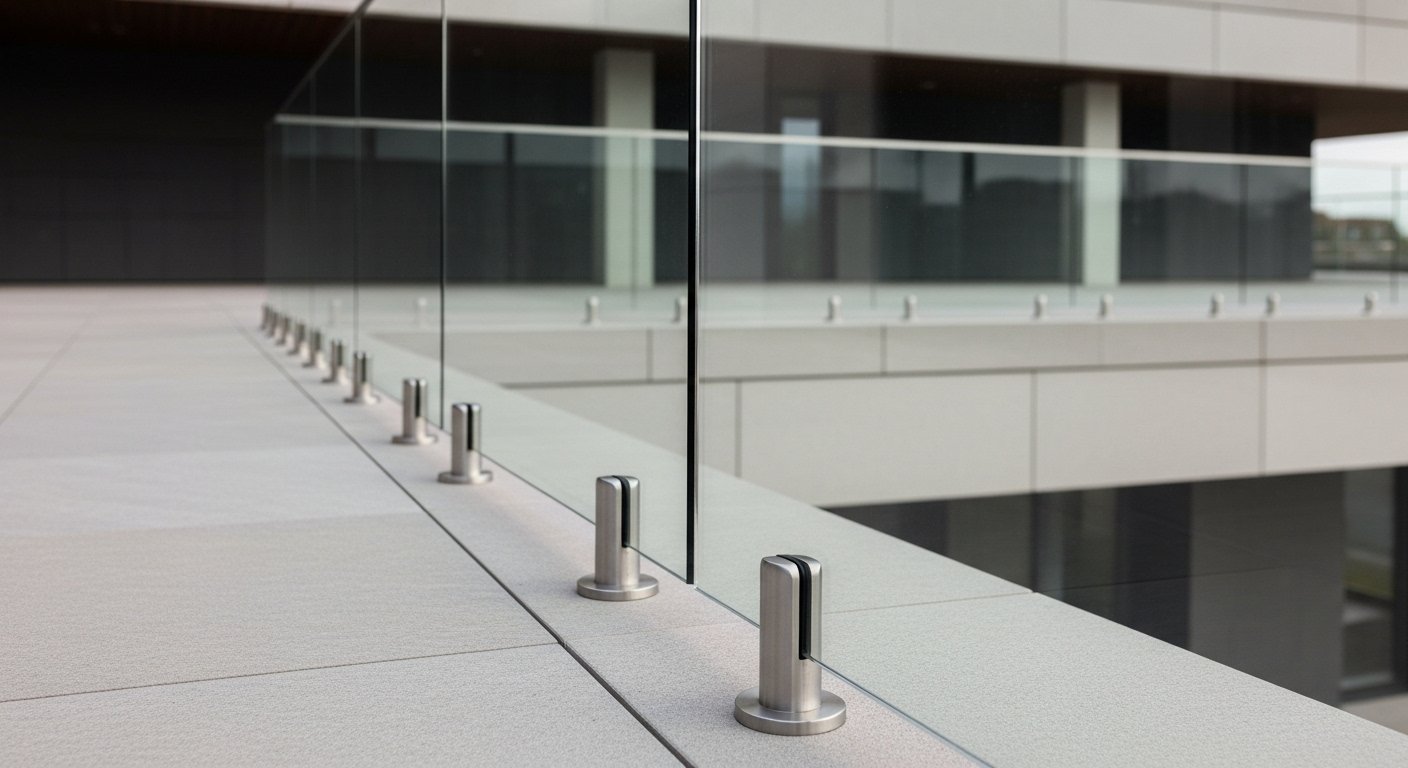
Spigots are point-fixed fittings that clamp or core-engage glass at discrete centres. They deliver the most "invisible" support line when consultants want minimal continuous metal at the slab.
- Common on prestige balconies, lobbies and amenity edges where appearance leads.
- Glass hole positions, spigot centres and anchor capacity must be coordinated before tempering.
- Deep product engineering: spigot glass railing system.
Standoff Systems
Standoffs / side-fixed point hardware hold glass off a vertical face or structural fin. They appear where the slab edge cannot take a continuous shoe, or where the architect wants glass to float visually from a wall or stringer.
- Useful on feature stairs and side-mounted balcony conditions.
- Alignment tolerance and substrate flatness are critical -- survey before fabrication.
Channel Systems
Channel systems (including embedded or fascia-mounted channels) secure glass in a continuous profile that may sit flush or near-flush with finishes. They are specified when parapet geometry, fascia mounting or concealed-shoe aesthetics drive the detail.
- Coordinate waterproofing and drainage with the faade / civil package.
- Confirm whether the channel is aluminium or stainless per corrosion and finish brief.
Hardware Options
Hardware selection covers shoes, spigots, standoffs, end caps, handrail buttons (where required), gaskets, packers and anchors. commercial BOQs should lock:
- Fixing family (shoe / spigot / standoff / channel)
- Metal grade (SS304 vs SS316 -- see below)
- Finish (satin, mirror, powder-coated aluminium where used)
- Anchor type compatible with slab strength and edge distance
Top-rail or handrail additions -- when NBC or user-need requires a graspable rail -- are coordinated with handrails without breaking the frameless glass plane below.
SS304 vs SS316 Hardware
Hardware grade is an exposure decision for Hyderabad's inland climate:
| Factor | SS304 hardware | SS316 hardware |
|---|---|---|
| Typical Hyderabad use | Many inland interiors and standard exterior edges with regular cleaning | Pool-adjacent decks, aggressive cleaning, chemical exposure, higher humidity wash-down |
| Cost position | Usually lower | Higher -- specify when exposure justifies |
| Specification note | Do not mix grades casually across a visible elevation. Lock grade on the approved shop drawing and BOQ. | |
Technical Specification Table
Indicative commercial matrix. Project values are confirmed on calculations and approved drawings.
| Parameter | Typical commercial range |
|---|---|
| Glass type | Toughened and/or laminated safety glass (IS 2553 / IS 16613 family as specified) |
| Glass thickness | Commonly ~10--15 mm class (or laminated build-up); locked per span and load |
| Interlayer | PVB or approved equivalent when laminated; thickness per specification |
| Hardware | Base shoe, spigot, standoff or channel -- SS304 / SS316 as exposure requires |
| Finish | Satin / mirror metal; clear, tinted or low-iron glass as specified |
| Application | Balconies, stairs, atriums, podium and terrace edges |
| Recommended environment | Hyderabad inland commercial; upgrade glass build-up / hardware for pool chemistry and high public exposure |
| Maintenance | Non-abrasive glass cleaners; inspect gaskets, silicone and anchors each monsoon season |
| Compliance | NBC 2016 guard height / opening intent; IS 875 Parts 3 & 5 (project-specific wind design wind + guard loads); glass standards as specified |
| Documentation | Shop drawings, glass MTCs (as available from supply chain), calculation summaries -- exact pack: VERIFICATION REQUIRED per order |
Manufacturing Process
Frameless packages are manufactured from our Hyderabad production facility with glass processing coordinated to approved hole maps and edge dimensions:
- Drawing lock -- fixing family, glass sizes, holes and hardware centres approved.
- Glass processing -- cutting, edging, tempering and/or laminating to the locked schedule.
- Hardware prep -- shoes, spigots or standoffs prepared and matched to panels.
- Fit check -- critical interfaces verified before phased Hyderabad dispatch.
- Protected packing -- edge and surface protection for road transit to tower sites.
Factory tempering-line / QC photography archive: MEDIA RECOMMENDED.
Quality Control
- Glass type, thickness and hole positions checked against approved drawings.
- Edge quality and stamp / marking reviewed where applicable to the glass process.
- Hardware finish and grade verified against the purchase order.
- Gaskets, packers and accessories kitted per floor / wing release.
- Packing inspection before dispatch to Hyderabad sites.
Independent lab tests beyond mill / processor MTCs: VERIFICATION REQUIRED per project requirement.
Why Frameless Glass Railings in Hyderabad
Hyderabad's commercial brief often pairs west-corridor view marketing with project-specific wind design wind detailing. Frameless edges win when balcony sightlines and atrium daylight are part of the product story -- but only when glass thickness, fixing centres and hardware grade are locked before tempering. Dust-heavy dry seasons and monsoon humidity also reward drainage detailing in shoes/channels and a documented cleaning habit for glass and stainless finishes.
Use this decision guide against metal-primary packages on the same campus:
| Decision factor | Prefer frameless glass | Prefer stainless / hybrid |
|---|---|---|
| Primary client value | Uninterrupted view, daylight, premium faade read | Impact durability, industrial traffic, heavy cleaning |
| Typical Hyderabad spaces | Sell-face balconies, atriums, amenity decks | Service cores, plant access, hospital corridors |
| Campus hybrid | Frameless edges on amenity/sell faces + SS packages on high-traffic cores -- see glass and SS Hyderabad authority pages | |
Fixing System Comparison
Lock one primary fixing family per typology before BOQ freeze. Mixing families on one elevation without consultant approval creates finish and structural inconsistency.
| System | How glass is held | Best Hyderabad fit | Watch-outs |
|---|---|---|---|
| Base shoe | Continuous channel at slab | Long balcony runs, repeat plates | Drainage + anchor edge distance |
| Spigot | Point fittings at centres | Prestige edges, amenity decks | Hole map locked before tempering |
| Standoff | Side-fixed point hardware | Feature stairs, wall-side edges | Substrate flatness / alignment |
| Channel | Continuous / fascia / embedded | Parapet and flush-finish briefs | Waterproofing interface |
Standards -- NBC, IS 875 & Glass References
- NBC 2016 -- guard height and opening intent for balconies, stairs and voids.
- IS 875 Part 3 -- India Wind project-specific wind design basis for external edges.
- IS 875 Part 5 -- imposed loads on guards and handrails for calculation summaries.
- IS 2553 family -- toughened safety glass call-outs when specified on the project.
- IS 16613 family -- laminated safety glass call-outs when fragment retention is required.
- GHMC / HMDA review context -- drawings and calculation summaries prepared for PMC technical files where required.
Advantages -- Why Builders Across India Choose Railings India
- Local manufacturing base -- frameless packages coordinated from our Hyderabad production facility.
- Fixing-family clarity -- base shoe vs spigot vs standoff vs channel decided with drawings, not guesswork.
- City + national depth -- India authority page linked to full system pages for engineering detail.
- Mixed-campus capability -- frameless glass edges alongside SS packages and broader glass railing scopes.
- Documentation discipline -- NBC / IS 875 summaries and shop drawings for commercial orders.
- Phased tower delivery -- glass releases matched to slab / wing handover where programmed.
Procurement Support for EPC & PMC Teams
- BOQ review -- glass thickness, interlayer, fixing type and missing accessories checked.
- Quantity estimation -- panel counts and hardware centres from drawings or schedules.
- Glass selection -- toughened vs laminated guidance by exposure and void risk.
- Hardware selection -- shoe / spigot / standoff / channel and SS304 vs SS316.
- Shop drawings -- DWG/PDF issued for approval before tempering / fabrication freeze.
- Tender support -- clarifications and alternates where value engineering is invited.
- Value engineering -- fixing-family or glass-build options that protect compliance intent.
- Technical consultation -- wind, span and edge-distance discussion against IFC details.
Project Workflow
- Enquiry -- share elevations, railing schedules, wind notes and preferred fixing family.
- Technical review -- glass build-up, hardware grade and substrate assessed.
- Commercial proposal -- clarified inclusions / exclusions for supply.
- Shop drawing approval -- hole maps and centres locked before glass processing.
- Fabrication & dispatch -- manufactured and phased to site readiness.
- Handover pack -- drawings and documentation for PMC close-out on commercial orders.
Installation Process
Frameless installation on towers depends on slab edge readiness, anchor capacity and protection from concurrent trades:
- Survey line and level; confirm edge distances before drilling.
- Set shoes / spigots / standoffs to approved centres; torque anchors per specification.
- Install glass with correct packers and bedding; protect edges until handover.
- Fit handrail buttons or top rails only where the approved detail requires them.
- Final clean with non-abrasive glass cleaners before PMC inspection.
Site installation photo archive for frameless Hyderabad packages: MEDIA RECOMMENDED.
Maintenance Guide
- Glass cleaning -- mild, non-abrasive cleaners; avoid metal scrapers on coated or soft surfaces.
- Hardware -- wipe metal with soft cloth; avoid chloride bleaches that can mark stainless finishes.
- Monsoon checks -- inspect silicone, gaskets, drainage paths and visible anchors after heavy rains.
- Dust load -- India's dry-season dust rewards more frequent glass cleaning on west-facing balconies.
- Impact events -- isolate damaged panels; do not leave compromised glass in public edges -- replace per safety protocol.
FAQs -- Frameless Glass Railing Manufacturer Hyderabad
1. Who manufactures frameless glass railings in Hyderabad?
Railings India manufactures commercial frameless glass railing systems from our Hyderabad production facility for builders and project teams buyers.
2. What fixing systems do you supply?
Base shoe, spigot, standoff and channel systems -- selected against slab geometry, span and appearance brief. Dedicated pages cover base shoe and spigot in depth.
3. Base shoe or spigot -- which is better for towers?
Base shoe often suits long balcony runs and repeat plates. Spigot suits prestige edges where minimal continuous metal is preferred. Final choice follows structural and architect approval.
4. What glass thickness is typical?
Many commercial packages start around 12 mm toughened, with laminated builds where fragment retention is required. Thickness is locked by calculation -- not a fixed catalogue SKU.
5. Do you use toughened and laminated glass?
Yes. Toughened and laminated (including toughened-laminated) options are supplied to the approved specification, with standards referenced as called on the project (commonly IS 2553 / IS 16613 families).
6. What wind zone applies in Hyderabad?
Hyderabad is IS 875 Part 3 Wind project-specific wind design. External frameless edges should be checked against project design wind pressure and IS 875 Part 5 guard loads.
7. Can you support NBC 2016 guard requirements?
Yes. Commercial packages are detailed with NBC 2016 height and opening intent in mind, with documentation suitable for PMC technical files on ordered projects.
8. SS304 or SS316 hardware?
SS304 suits many inland Hyderabad conditions. SS316 is preferred for pool-adjacent and chemically aggressive exposures. Lock one grade per visible elevation.
9. Which Hyderabad areas do you serve?
HITEC City, Gachibowli, Financial District, Kokapet, Madhapur, Raidurg, Nanakramguda, Secunderabad, Banjara Hills, Jubilee Hills, and ORR pockets including Patancheru and Jeedimetla campuses where glass edges are specified.
10. Do you provide shop drawings before tempering?
Yes. Hole maps, centres and glass sizes are approved on shop drawings before glass processing freeze on commercial orders.
11. Can procurement get BOQ review help?
Yes. We review BOQs for glass build-up, fixing family, hardware grade and missing accessories before order release.
12. How is frameless different from semi-frameless?
Frameless minimises visible posts so glass dominates the edge. Semi-frameless may retain more metal structure. Your IFC detail and appearance brief decide the family.
13. Do you install as well as supply?
Installation support and site coordination are available for commercial packages as agreed in the order scope.
14. What documents are available on request?
Shop drawings, material certificates as available from the supply chain, and calculation summaries. Exact contents are confirmed per order -- no placeholder PDFs are published here.
15. How do I start a Hyderabad frameless enquiry?
Share drawings or a BOQ via Get a Quote or Contact Us. Note preferred fixing family (base shoe / spigot / other), glass type and whether the package is balcony, stair or atrium.
Related Products
Downloads Available On Request
Available on request for qualified commercial enquiries -- not published as placeholder PDFs:
- Typical frameless edge detail sheets (after scope confirmation)
- Base shoe / spigot selection notes
- Shop drawing title-block samples
- Glass cleaning / maintenance guidance
- Company capability statement via manufacturer credentials
Commercial CTA -- India Frameless Enquiry
Share your tower or campus drawings for frameless glass railing packages. We respond with fixing-family clarification, glass build-up options and a commercial proposal suitable for EPC and PMC review.
Get a Quote Contact Us