Sector Specification Guide — Aviation Infrastructure
Glass balustrades, SS 316 handrails and aviation-grade guardrails for passenger terminals, concourses, boarding bridges and cargo facilities — IS 875, NBC 2016 and AAI-compatible documentation for PMC, EPC and airport authority programmes.
Request Aviation SpecificationSpecification reference for AAI projects, PMC submittals and EPC tender packages — load tiers, glass make-up, SS grades and documentation checklist.
Download Airport-Railing-Systems-Technical-Guide.pdf RI-AV-TECH-GUIDE-2026Railings India supplies railing and glazing systems for airport terminals, aviation infrastructure and metro–airport integrated facilities across India. Systems are engineered for assembly crowd loads, high-traffic durability and authority-grade documentation on every order.
Integrated packages cover landside and airside balustrades, mezzanine guards, stair and ramp handrails, and security-screening zone barriers. Specification is zoned by occupancy load and SS grade per PMC-approved schedule.
High-traffic arrival circuits specify SS 316 handrails and laminated glass balustrades at 3.0 kN/m. Fixings are selected for impact resistance and intensive cleaning cycles. Fragment-retention glazing is mandatory in baggage hall adjacencies.
Departure concourses use frameless or base-shoe glass balustrades for visual openness at check-in halls and emigration queues. RI-FG-01 frameless systems are standard at premium terminal atria.
Concourse balustrades at retail and gate circulation zones require 3.0 kN/m assembly documentation. Semi-frameless post-and-glass systems allow efficient panel replacement without full concourse closure.
Controlled zones may require framed guards, higher post stiffness and non-climbable infill geometry. Coordination with security consultant layouts ensures gate and queue railing interfaces align with equipment placement.
Jet bridge and boarding bridge balustrades are engineered for apron wind exposure, humidity and assembly loads. SS 316 fixings and 12.38 mm SGP laminated glass are typical at airside interfaces.
Airside viewing galleries and mezzanine overlooks use spigot or frameless systems for maximum transparency. Wind load on exposed elevations is confirmed per IS 875 Part 3 with importance factor 1.5.
Atria, transfer bridges and multi-level connector corridors require consistent load tier and handrail continuity across level changes. Shop drawings coordinate expansion joints and structural movement at bridge interfaces.
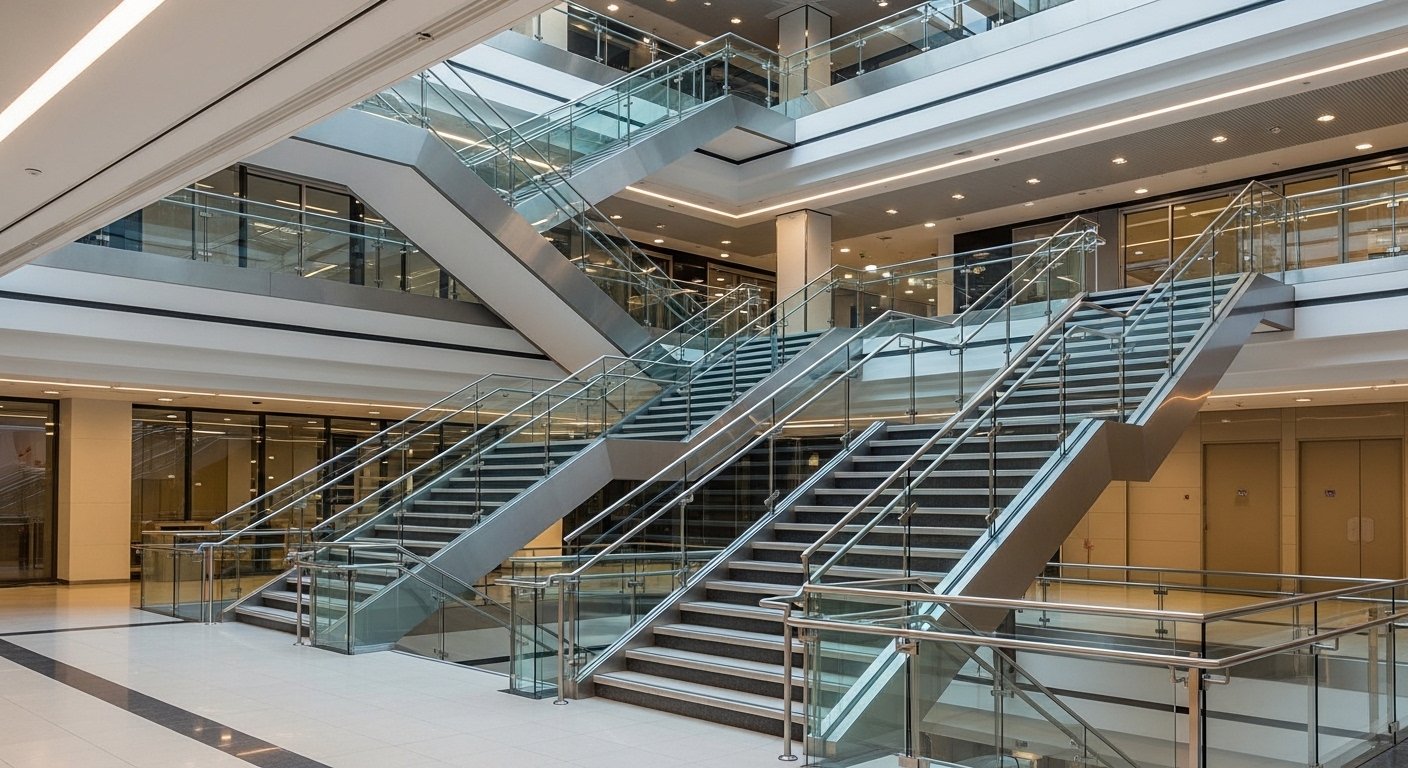
Airport projects in India are governed by NBC 2016, IS 875, MoCA/AAI technical review and project-specific PPP or EPC contract specifications. Railings India aligns submittals to these frameworks on every aviation order.
AAI and PPP airport programmes require third-party-verifiable material test certificates, stamped structural calculations, shop drawings reviewed by the project structural engineer, and mock-up approval for visible public-zone balustrades. Document numbering and revision control follow PMC registers.
Terminal zones are classified as assembly occupancy. Guard heights, imposed loads and the 100 mm sphere rule on openings are confirmed per NBC 2016 Part 4. Height compliance statements are issued by zone on shop drawings.
IS 875 Part 5 governs horizontal imposed loads — 3.0 kN/m at assembly concourses. IS 875 Part 3 wind loads apply Importance Factor 1.5 for essential airport facilities on exposed elevations and boarding bridge interfaces.
Arrival and departure circuits experience sustained lateral crowd pressure. SS 316 handrails and laminated glass panels are specified for wear resistance. Post centres and base fixings are sized for 3.0 kN/m, not standard commercial 1.5 kN/m tiers.
Balustrade design must prevent climb points, manage expansion joint movement at concourse bridges, and retain glass fragments in public zones through laminated or SGP interlayers per IS 16613.
Glass balustrades provide transparency at terminal atria, concourses and viewing galleries. All airport glass is specified to Indian standards with batch MTC traceability.
RI-FG-01 frameless glass railing system — base channel or structural silicone-set panels for departure lounges and atria. Maximum transparency at assembly load 3.0 kN/m with documented wind engineering.
RI-BS-01 base shoe glass railing — aluminium or SS base profiles at slab edge for repeatable concourse floor plates. Efficient installation on phased terminal expansions.
Point-fixed SS 316 spigots for viewing galleries and prestige interior zones. Minimum 12 mm toughened or 12.38 mm laminated glass with precision slab-edge setting.
Toughened laminated glass to IS 16613 with 1.52 mm PVB or SGP interlayer in all public assembly zones. SGP specified at high-impact assembly and airside edges. See glass railings hub for full specification matrices.
Landside and airside circulation balustrades are zoned on shop drawings with load tier, glass make-up and SS grade per PMC schedule. Fragment-retention glazing is non-negotiable in passenger-facing areas.
SS handrails and post-and-glass systems form the durable backbone of airport circulation infrastructure.
SS 304 suits dry landside interior handrail runs, back-of-house corridors and low-chloride environments. Economical for long linear handrail programmes where 316 upgrade is not mandated by environment class.
SS 316 is mandatory for arrival/departure circuits, coastal airports (e.g. GMR Hyderabad), airside exterior, boarding bridge interfaces and high-traffic wipe-down zones. See stainless steel railings for tube profiles and finishes.
Airport terminals demand non-porous, impact-resistant surfaces. SS 316 with No.4 satin finish is standard for public handrails subject to continuous passenger contact and cleaning cycles.
No.4 satin hides minor abrasion. Avoid chloride cleaners on SS 316 exterior packages. Annual fixing inspection is recommended on high-traffic concourse handrails. O&M manuals define cleaning agents and inspection intervals.
Airport assets operate 20–30 year design lives. SS 316 selection at procurement avoids mid-life replacement cycles on coastal and high-traffic zones. Passivation after fabrication restores corrosion resistance on all SS 316 orders.
Procurement reference for architects, PMC teams and EPC contractors selecting airport railing systems by terminal zone.
| Terminal zone | Material | Glass thickness | Handrail | Fixing system | Finish | Application |
|---|---|---|---|---|---|---|
| Departure concourse | SS 316 + laminated glass | 10.38–12.38 mm laminated | SS 316 cap rail optional | RI-FG-01 / RI-BS-01 | #4 satin | Assembly 3.0 kN/m |
| Arrival hall | SS 316 | 10.38 mm laminated min. | 38–50 mm OD IS 4270 | Wall / post mount | #4 satin | High-traffic handrail |
| Terminal atrium | SS 304/316 + glass | 12 mm toughened min.; laminated public | Integrated cap rail | Spigot / frameless | #4 / #8 mirror | Multi-level void |
| Boarding bridge | SS 316 + SGP glass | 12.38 mm SGP laminated | SS 316 continuous | Base channel / spigot | Passivated | Airside humidity |
| Ramp / escalator | SS 316 | N/A | 38–50 mm OD | Bracket to structure | #4 satin | HAG accessible |
| Cargo utility | MS HDG / SS 316 | N/A | 42 mm OD tube | Base plate / core drill | HDG / passivated | Industrial 1.5 kN/m + 890 N |
Reference matrix for AAI projects and EPC tender packages. Assembly zones require 3.0 kN/m per IS 875 Part 5.
| Location | NBC occupancy | Min height (mm) | Load (kN/m) | Glass spec | SS grade | Authority |
|---|---|---|---|---|---|---|
| Landside departure concourse | Assembly | 1100–1200 | 3.0 | 10.38 mm laminated (IS 16613) | SS 316 | NBC + AAI margin |
| Airside restricted balustrade | Assembly | 1200 | 3.0 | 12.38 mm SGP laminated | SS 316 | AAI + structural engineer |
| Metro–airport link bridge | Assembly | 1050–1100 | 3.0 | 10.38 mm laminated | SS 316 | IS 875 + metro authority |
| Terminal atrium edge | Assembly | 1050–1200 | 3.0 | 12 mm min.; laminated public | SS 304 / 316 | NBC Clause 3.3.3 |
| Ramp & escalator handrails | Assembly | 900 (from nosing) | 1.5 | N/A | SS 316 | HAG + IS 4270 |
| Cargo apron walkway | Industrial | 1100 | 1.5 + 890 N point | N/A | SS 316 / HDG MS | IS 875 industrial |
Railings India supplies a structured documentation package for airport PMC, AAI review and EPC handover. Request via project enquiry.
| # | Document | Format | PMC / authority use |
|---|---|---|---|
| 1 | IS 875 Part 3 wind load (IF 1.5) | PDF + calc sheet | Design basis approval |
| 2 | IS 875 Part 5 load confirmation (3.0 kN/m assembly) | BOQ / spec verification | |
| 3 | NBC 2016 height compliance by zone | Authority submittal | |
| 4 | Stamped shop drawings | DWG + PDF | GFC approval |
| 5 | Glass MTC — IS 2553 / IS 16613 | PDF per batch | Material approval |
| 6 | SS MTC — grade 304/316 + finish | PDF per batch | Material approval |
| 7 | Installation method statement | Site safety plan | |
| 8 | Third-party inspection letter | AAI / QA protocol | |
| 9 | Mock-up panel protocol | PDF + photos | Visual + performance approval |
| 10 | O&M manual | Handover dossier |
| Stage | EPC action | Railings India deliverable | Duration | Approval gate |
|---|---|---|---|---|
| 1. Enquiry | Share GA, zone map, railing schedule | Budgetary spec + compliance matrix | 2–3 days | PMC technical review |
| 2. Technical submittal | Issue LOI / draft PO | Full document pack (items 1–7) | 5–7 days | PMC + airport authority |
| 3. Shop drawing approval | Comment fixings, post centres | Revised stamped drawings | 7–10 days | PMC design freeze |
| 4. GFC release | Confirm quantities per zone | Final BOQ + production release | 2 days | EPC procurement |
| 5. Fabrication | Confirm phase programme | Factory QA + batch MTCs | 4–8 weeks | EPC factory inspection |
| 6. Mock-up | Install sample panel | Test + approval report | 1–2 weeks | Architect + PMC |
| 7. Dispatch | Zone-wise delivery | Packed panels + install guide | Per programme | Site logistics |
| 8. Handover | Submit as-built dossier | O&M + compliance pack | 3–5 days | Authority close-out |
Railings India, part of Sun Corporation India, supplies aviation infrastructure from Hyderabad. See manufacturer credentials and projects portfolio.
| Project | Scope | Key specification | Documentation |
|---|---|---|---|
| GMR Hyderabad Airport | Glass balustrade + SS systems | SS 316, laminated glass, IS 875 | IS 875 + NBC + shop drawings |
| Airport Terminal Expansion (South India) | Frameless balustrade + SS 316 handrails | 3.0 kN/m assembly circuits | AAI-compatible submittal pack |
| L&T Metro Hyderabad | SS 316 handrails — metro–airport link | 14 stations, IS 4270 + HAG | Third-party inspection |
| Airport cargo / utility zones | Industrial safety guard rails | IS 800 + IS 875, 890 N point | Full engineering package |
View case studies → · Projects portfolio →
What railing systems are specified for airport passenger terminals in India?
Airport passenger terminals typically specify frameless or semi-frameless glass balustrades at assembly load 3.0 kN/m in departure and arrival concourses, SS 316 handrails on ramps and escalator approaches, and laminated safety glass (IS 16613) in all public circulation zones. Railings India supplies RI-FG-01 frameless, RI-BS-01 base shoe and RI-SP-01 spigot systems with AAI-compatible documentation.
What glass thickness is recommended for airport balustrades?
Landside concourses: minimum 10.38 mm toughened laminated glass (IS 16613). High-traffic assembly zones and airside restricted areas: 12.38 mm SGP laminated glass. Boarding bridge edges and viewing galleries over active apron: project-specific IS 875 Part 3 wind confirmation with structural engineer sign-off. Glass make-up is confirmed on stamped shop drawings.
What stainless steel grades are used in airport railing projects?
SS 304 (EN 1.4301) is used for dry landside interior handrail runs with moderate cleaning cycles. SS 316 (EN 1.4401) is specified for arrival and departure circuits, coastal airports, airside exterior zones, wash-down areas and boarding bridge interfaces where chloride exposure and high-traffic wear demand superior corrosion resistance.
How are airport railing systems tested for public crowd loads?
Design basis is IS 875 Part 5 assembly load of 3.0 kN/m for public concourse balustrades, confirmed on calculation sheets. Mock-up panels may be impact-tested and visually approved per architect and PMC protocol. Third-party inspection witnesses fabrication QA and site fixing torque on AAI and PPP airport programmes.
What is the NBC 2016 guard height for airport assembly zones?
NBC 2016 Part 4 requires minimum 1050 mm for commercial guards; airport assembly concourses typically specify 1100–1200 mm as a project safety margin for crowd-loaded edges. Stair handrails require 900 mm from the nosing line. Railings India issues zone-wise NBC compliance statements on shop drawings for authority submittal.
Does IS 875 Importance Factor 1.5 apply to airport terminal glazing and railings?
Yes. Airport terminal buildings are essential facilities under NBC 2016. IS 875 Part 3 wind load calculations for exposed elevations, boarding bridge interfaces and tall atria typically apply Importance Factor 1.5, increasing design wind pressure versus standard commercial buildings of the same height. Wind calc sheets are supplied for PMC review.
What documentation is provided for airport EPC contracts?
Standard AAI/EPC submittal includes IS 875 Part 3 wind calculations, IS 875 Part 5 load confirmation, NBC height statements, stamped shop drawings (DWG + PDF), glass and SS batch MTCs, method statement, third-party inspection letter, mock-up protocol and O&M manual. Request the Airport Project Documentation Package via project enquiry.
Can Railings India support phased airport expansion programmes?
Yes. Zone-wise BOQ release, phased fabrication and dispatch align to terminal expansion wings, pier extensions and concourse refurbishment schedules. A single POC coordinates PMC, architect and EPC teams across multiple work packages with consistent specification and document numbering.
What fixing systems are used for airport glass balustrades?
Frameless systems use SS 316 base channel or structural silicone-set panels at slab edge. Base shoe systems (RI-BS-01) anchor aluminium or SS profiles on repeatable concourse slabs. Spigot systems (RI-SP-01) provide point-fixed transparency for atria and viewing galleries. Fixings are documented on method statements with torque and sealant maintenance intervals.
When is laminated glass mandatory in airport terminals?
Toughened laminated glass with PVB or SGP interlayer is mandatory in all public assembly areas, overhead glazing above circulation, boarding bridge edges and any zone where fragment retention is a safety requirement. Toughened-only panels are limited to controlled non-public back-of-house zones per security design.
What handrail specification applies to airport ramps and escalators?
Continuous SS 316 handrails in 38–50 mm OD profiles per IS 4270, with HAG dual-height configurations where accessibility routes adjoin escalators. Handrails are specified at 900 mm from ramp surface or stair nosing. See the handrails specification guide for grip profile and bracket details.
How does Railings India coordinate with airport PMC consultants?
PMC coordination includes document register alignment, shop drawing revision cycles, mock-up approval gates, third-party inspection scheduling and as-built dossier at handover. Technical submittals are formatted for AAI and PPP airport authority review with calc sheet stamps and MTC batch traceability.
What surface finishes are specified for airport SS handrails?
No.4 satin (#4 hairline) is standard for high-traffic public circuits — hides minor abrasion and supports wipe-down cleaning. Electropolished SS 316 is optional for premium lounges and VIP circulation. Powder coat is avoided on primary grip surfaces in assembly zones.
Are industrial safety railings required in airport cargo and utility zones?
Yes. Cargo aprons, fuel farm perimeters, plant terraces and maintenance walkways require IS 875 industrial guards with 1.5 kN/m distributed load and 890 N point load, often in HDG MS or SS 316. See industrial safety railings for mezzanine and utility specifications.
What is included in airport shop drawing packages?
Plan and elevation layouts by zone, slab-edge channel details, post centres, glass panel sizes, anchor schedules, expansion joint coordination, handrail bracket details and NBC height datums. Drawings are issued DWG + PDF with revision clouding for PMC GFC approval.
Does Railings India supply boarding bridge balustrade systems?
Yes. Boarding bridge and jet bridge interface balustrades are engineered for assembly loads, wind exposure at apron level and SS 316 fixings for exterior humidity. Glass make-up typically 12.38 mm SGP laminated with project-specific IS 875 Part 3 confirmation.
What maintenance programme applies to airport glass balustrades?
O&M manuals specify sealant inspection intervals, anchor torque re-check schedules after opening year, panel replacement procedure and cleaning agents safe for SS 316 and glass coatings. High-traffic terminals typically inspect fixings annually and sealants biannually.
Can glass and SS airport railing packages be procured under a single EPC PO?
Yes. Combined packages cover concourse balustrades, stair and ramp handrails, mezzanine guards and cargo utility barriers with unified shop drawings, single MTC register and coordinated dispatch programme — reducing PMC document fragmentation.
What project references does Railings India hold in aviation infrastructure?
Published portfolio includes GMR Hyderabad Airport, Airport Terminal Expansion (South India), L&T Metro Hyderabad integration works and airport cargo utility zones. See case studies and projects for specification summaries — no additional project names beyond published portfolio.
How do I request an airport railing technical submittal pack?
Submit architectural GA, zone-wise railing schedule and terminal phase programme via get-a-quote. Technical response within 24 hours includes system recommendation, compliance matrix and documentation scope. Download the Airport Railing Systems Technical Guide PDF for specification reference.
Zone-wise phased dispatch to greenfield airports, terminal expansions and retrofit programmes nationwide.
Single POC for structural submittal, shop drawing revisions, mock-up coordination and handover dossier.
Document registers, calc stamps and MTC batches formatted for AAI and PPP airport authority review.
IS 875 IF 1.5 wind calcs, assembly load confirmation, NBC statements and O&M manuals on every aviation order.
ISO 9001:2015 factory QA, optional third-party inspection, batch glass and SS traceability.
Reference supply includes GMR Hyderabad Airport and airport terminal expansion programmes with full submittal packs.
Share terminal GA, zone railing schedule and phase programme. Technical response within 24 hours with specification recommendation and AAI-compatible documentation scope.
Request Aviation Specification Download Technical Guide PDF